EMI Full Form and How EMIs Affect Your Credit Score
❤️ Spread the Love
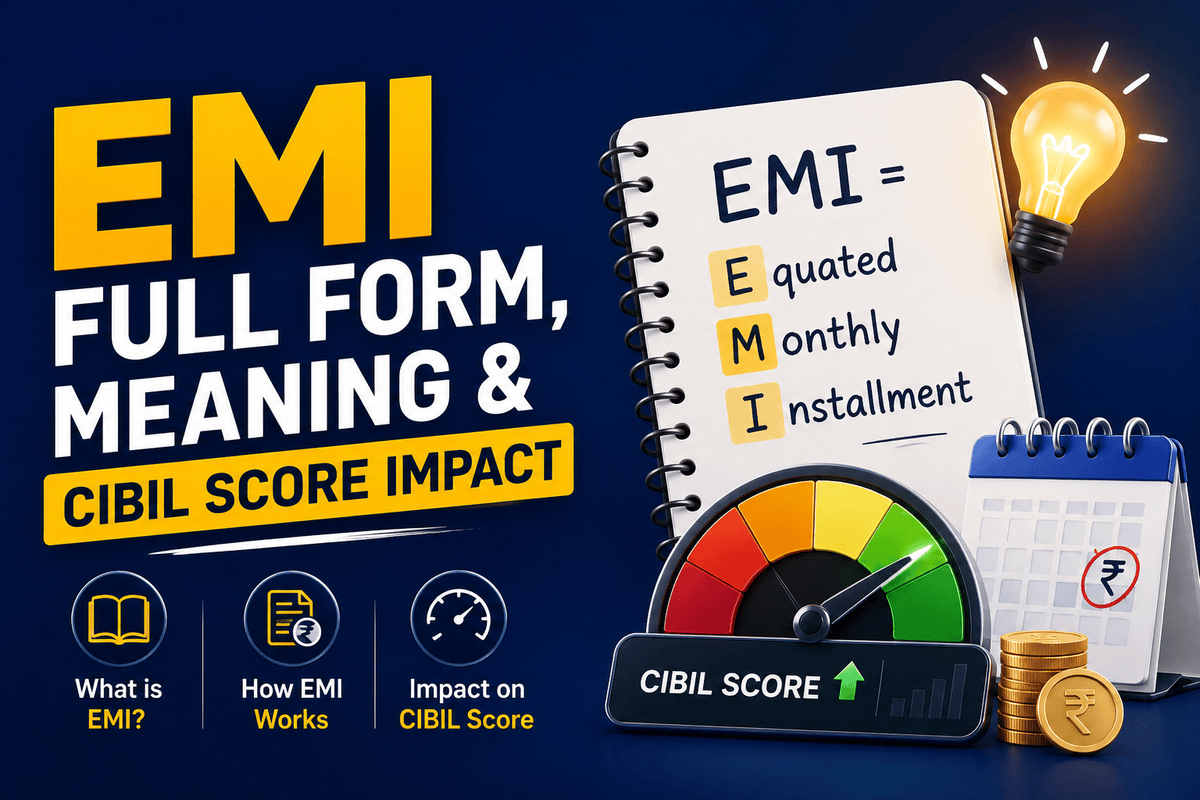
EMI stands for Equated Monthly Instalment. It is the fixed amount you pay towards a loan every month. An EMI generally includes two parts: the principal amount borrowed and the interest charged by the lender. Paying your EMIs on time can help maintain a healthy credit history, while missed or delayed payments can negatively affect your CIBIL score.
What does EMI mean?
When you take a loan, you usually do not repay the entire borrowed amount at once. Instead, the lender divides the repayment into monthly instalments over an agreed tenure.
Each EMI consists of:
Principal: The original amount you borrowed.
Interest: The cost charged by the lender for providing the loan.
Tenure: The period over which you repay the loan.
For example, if you take a personal loan, your lender may structure the repayment into monthly installments for a specific number of months. You pay the agreed EMI every month until the loan is fully repaid.
The word “equated” refers to the EMI generally remaining the same throughout the repayment period for a standard fixed-rate loan. However, the proportion going towards principal and interest can change over the course of the loan.
At the beginning, a larger portion of the EMI may go towards interest. As the outstanding principal reduces, the principal component generally becomes a larger part of subsequent installments.
What is EMI in banking?
In banking, an EMI is the scheduled monthly repayment made towards a loan. It allows borrowers to spread repayment of the principal and interest over the agreed loan tenure instead of making one large payment.
EMIs are common with products such as:
Personal loans
Home loans
Car loans
Education loans
Consumer loans
Your EMI amount depends on factors such as the loan amount, interest rate and repayment tenure.
How is an EMI calculated?
The exact EMI depends on three main variables:
Loan amount + interest rate + loan tenure
A commonly used EMI formula is:
EMI = P × R × (1 + R)ⁿ / [(1 + R)ⁿ – 1]
Where:
P = principal loan amount
R = monthly interest rate
n = number of monthly instalments
You do not need to calculate this manually every time. Lenders and financial platforms typically provide EMI calculators that can estimate the monthly repayment based on the loan amount, rate and tenure.
One important point: a longer tenure can reduce your monthly EMI, but it can also mean paying interest for a longer period. So choosing a loan should not be based only on whether the EMI looks affordable.
How do EMIs affect your CIBIL score?
Your EMI payment behaviour can directly affect your credit history when the lender reports your loan account and repayment information to the credit bureau.
The simplest way to understand it is:
On-time EMI payments → positive repayment behaviour
Missed or delayed EMI payments → negative repayment behaviour
Payment history is an important part of your credit profile, so consistently paying your EMIs by the due date is an essential credit habit.
How EMIs can help your credit score?
EMI behaviour | Possible credit impact |
Paying every EMI on time | Supports a healthy repayment history |
Paying the full scheduled EMI | Keeps the loan account in good standing |
Maintaining a consistent repayment record | Helps establish responsible credit behaviour |
Keeping loan obligations manageable | Can support overall creditworthiness |
When you make your scheduled payments on time, you demonstrate that you can manage borrowed money responsibly.
This becomes particularly important if you are building your credit history. A loan that is managed responsibly can add a positive repayment track record to your credit profile.
How EMIs can hurt your credit score?
EMI behaviour | Possible credit impact |
Missing an EMI | Can negatively affect your credit history |
Paying after the due date | May be reported as delayed repayment |
Repeated payment delays | Can weaken your credit profile |
Taking on more debt than you can comfortably repay | Can affect your overall creditworthiness |
A missed EMI is therefore more than just a late payment to the lender. Depending on the lender's reporting practices and the details of the account, repayment delays can appear in your credit report and affect your credit profile.
That's why paying your EMI on time matters more than simply having a loan.
Do too many EMIs hurt your CIBIL score?
Having multiple EMIs does not automatically lower your CIBIL score. The bigger concern is whether your total debt obligations become difficult to manage.
For example, imagine someone has:
A personal loan EMI
A car loan EMI
A home loan EMI
Multiple credit card repayments
Each individual loan may be paid on time. But if the combined obligations consume too much of their available income, taking another loan may become difficult to manage.
Lenders may consider your existing obligations when assessing your ability to repay additional credit. A high level of debt can therefore affect your creditworthiness, even if you have not missed a payment.
This is why you should not take a new loan simply because the monthly EMI appears affordable.
Before borrowing, consider the total repayment obligation, not just the EMI of the new loan.
What about credit card EMIs?
Credit card purchases converted into EMI are different from traditional loans, but repayment behaviour can still matter for your credit profile.
If you convert a credit card transaction into an EMI, make sure you understand the repayment schedule, applicable charges and how the arrangement works. Most importantly, continue making the required payments on time.
Your overall credit card management also matters, including how much of your available credit you use.
How to make sure your EMIs don't hurt your credit?
A few simple habits can make loan repayment easier to manage.
1. Set up auto-debit:
If your lender offers an auto-debit facility, you can use it to reduce the risk of forgetting a due date.
However, do not treat auto-debit as a substitute for monitoring your account. Make sure sufficient funds are available before the payment date.
2. Keep a repayment buffer:
Try to maintain enough money in your account to cover upcoming EMIs and essential expenses.
A financial buffer can be especially useful when your income varies from month to month.
3. Don't borrow based only on EMI affordability:
A lender offering a particular EMI does not necessarily mean that the loan is comfortable for your overall budget.
Look at:
Total loan obligation + existing EMIs + essential monthly expenses
before taking on additional debt.
4. Track your repayment dates:
Keep a simple record of your EMI due dates. Missing a payment because you forgot the date is an avoidable problem.
5. Monitor your credit report:
Regularly reviewing your credit report can help you identify incorrect information, unexpected accounts or repayment entries that need attention.
If you notice an error, contact the relevant lender or credit bureau and follow the applicable dispute process.
How Credit Assist can help you stay credit-ready?
Understanding your EMI and credit score connection is only one part of managing your credit.
Credit Assist helps you stay more informed about your credit profile so you can make better decisions before and during your borrowing journey.
Whether you are building your first credit history, managing existing loans or working towards becoming more credit-ready, keeping track of your credit behaviour can help you avoid preventable mistakes. Stay informed. Stay prepared. Stay credit-ready with Credit Assist.
Conclusion
EMI means Equated Monthly Instalment, but its importance goes beyond simply knowing the full form. EMI simply means your monthly loan payment. Pay it on time, borrow only what you can comfortably repay, and keep track of your dues. These simple habits can help you build a stronger credit history over time.
Frequently Asked Questions
What is the full form of EMI?
Does paying EMIs improve your credit score?
Does a missed EMI affect your CIBIL score?
Do too many EMIs lower your credit score?
Does a credit card EMI affect your credit score?
About the Author
Khushi Mishra
@khushi.mishra@paymeindia.in
View all posts →