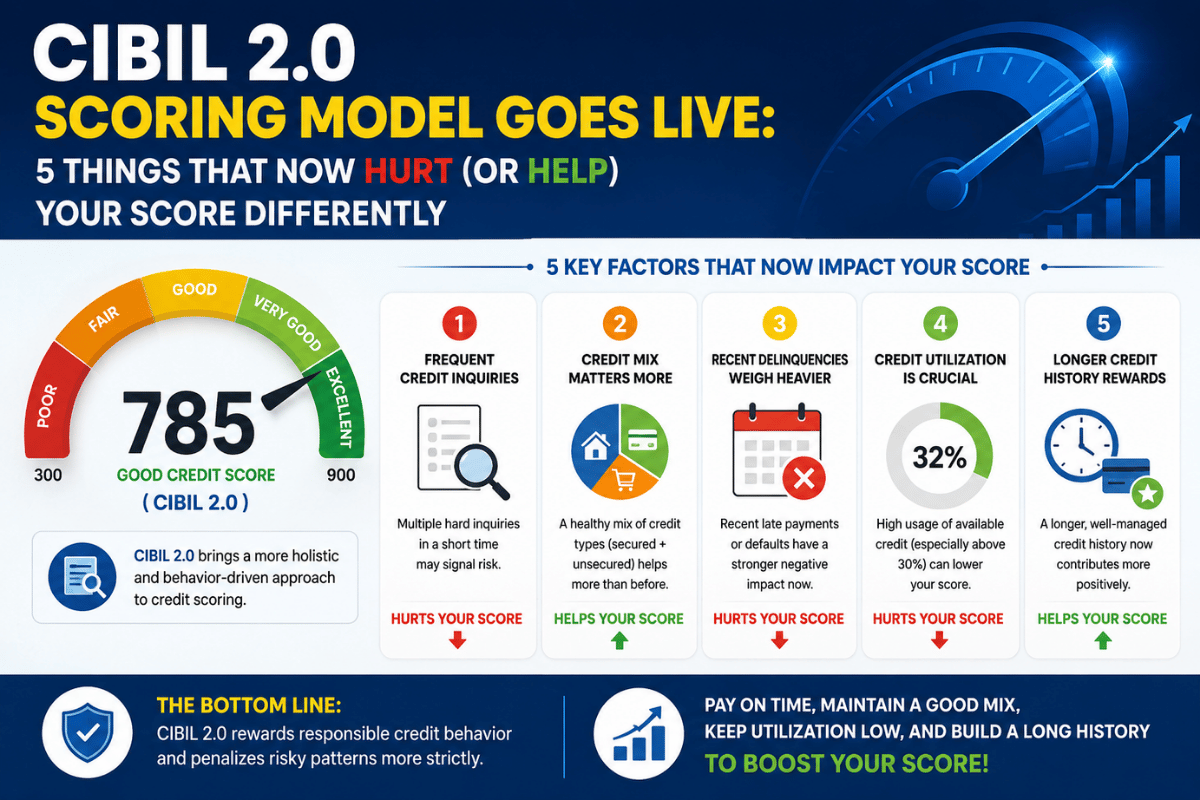
CIBIL 2.0 Scoring Model Goes Live: 5 Things That Now Hurt (or Help) Your Score Differently
❤️ Spread the Love
Last month, a reader named Amit reached out after his CIBIL score dropped 47 points despite doing everything "right" — he hadn't missed a single payment in three years, kept his credit utilisation under 30%, and even closed an old credit card to "clean up" his profile. What Amit didn't know was that the very action he thought would help — closing that decade-old card — had just cost him dearly under the new scoring model. TransUnion CIBIL's 2.0 algorithm, which quietly went live across most lenders in India this June, has fundamentally changed how your credit score is calculated. The playbook that worked for the past decade? Large parts of it are now obsolete.
What Actually Changed in CIBIL 2.0
The credit bureau hasn't exactly held a press conference about this, but the changes are real and significant. CIBIL 2.0 represents the most substantial algorithm overhaul since the bureau began operations in India. The new model draws from a larger data pool, weighs certain behaviours differently, and — most importantly — uses machine learning to identify patterns that the older, more linear model simply couldn't detect.
The core philosophy has shifted from static snapshots to behavioural trajectories. Previously, your score was largely a reflection of where you stood at any given moment. Now, the algorithm cares deeply about where you're heading. Are your balances trending down or up? Is your payment timing improving or deteriorating? This directional analysis means two people with identical credit profiles today could have meaningfully different scores based on their six-month trend lines.
For Indian consumers, this is both an opportunity and a risk. If you've been gradually improving your credit habits, you may see unexpected score gains. If you've been coasting on a historically good profile while slowly slipping, the new model will catch that — and penalise it.
5 Things That Now Hurt or Help Your Score Differently
1. Closing Old Accounts Now Causes Real Damage
Under the old model, closing an unused credit card had a minor impact, mostly through reducing your available credit. Under CIBIL 2.0, the penalty is steeper because the algorithm now places significantly more weight on credit history length — specifically, the age of your oldest active account. Amit's closed card was 11 years old. His next oldest account? Just three years. That single action aged his credit profile down by eight years in the algorithm's eyes.
The new rule: Keep old accounts open, even if dormant. Use them once every few months for a small purchase to keep them active.
2. Payment Timing Matters, Not Just Payment Completion
Paying your credit card bill on the due date used to be identical to paying it a week early, as far as your score was concerned. Not anymore. CIBIL 2.0 tracks how close to the due date you typically pay and treats consistent early payers as lower risk. The data shows that people who always pay at the last minute are statistically more likely to eventually miss a payment. The algorithm has learned this pattern.
The new rule: Set up auto-pay for at least the minimum due, but try to clear balances 5-7 days before the due date when possible.
3. Credit Mix Has Become More Nuanced
The old advice was simple: have a mix of secured and unsecured credit. The new model is more sophisticated. It now distinguishes between productive credit (home loans, education loans) and consumption credit (personal loans for lifestyle expenses, excessive buy-now-pay-later usage). A portfolio weighted toward productive credit now scores better than one dominated by consumption borrowing.
4. Inquiry Clustering Gets a Pass
Here's some good news. CIBIL 2.0 has finally adopted what's called rate shopping logic. If you apply for multiple home loans or auto loans within a 14-day window, the algorithm treats this as a single inquiry rather than multiple hits. This acknowledges the reality that smart borrowers shop around for the best rates. Previously, each application dinged your score individually.
5. Utilisation Volatility Now Gets Tracked
It's not enough to keep your credit utilisation under 30% anymore — the algorithm now monitors utilisation patterns over time. Someone who consistently uses 25% of their limit scores better than someone who swings between 5% and 50%, even if their average is the same. Stability signals reliability.
The Oversimplified Advice You Should Stop Following
Let me push back on something you'll hear constantly: "Just pay your bills on time and your score will be fine." This was never entirely true, but under CIBIL 2.0, it's actively misleading. Payment history remains important — roughly 35% of your score still depends on it — but the other 65% is influenced by factors that "pay on time" advice completely ignores.
I've seen people with perfect payment records stuck at 720 because they have no credit mix diversity, or because they habitually max out their cards mid-cycle before paying them off, or because their only loan is a recent personal loan for a vacation. The new algorithm sees through surface-level good behaviour to evaluate underlying risk patterns. You can do everything "right" by the old rules and still watch your score stagnate or decline.
The inverse is also true. Someone recovering from past mistakes can now see faster score improvements if their recent trajectory is strongly positive. CIBIL 2.0 is more forgiving of old errors and more attentive to current momentum.
How to Audit Your Profile Under the New Model
Pull your full credit report from the credit bureau — not just the score, but the detailed report. Look at it through the lens of the new factors:
Check your oldest account: Is it still open and active? If you closed old accounts recently, the damage is done, but you can prevent further erosion.
Review your payment timing: Look at when payments are actually posting, not when you're initiating them.
Assess your credit mix: What's the ratio of productive to consumption credit? If you're heavy on personal loans and BNPL, consider whether a secured loan might balance your profile.
Calculate your utilisation consistency: If you're spiking high mid-cycle, you're being tracked even if you pay in full.
Most importantly, stop treating your credit score as a number to check occasionally and start thinking of it as a living metric that reflects your ongoing financial behaviour.
The shift to CIBIL 2.0 isn't good or bad news universally — it's a more accurate system that rewards genuinely stable credit behaviour and penalises patterns that look good but carry hidden risk. If you've been gaming the old system with surface-level tactics, you'll need to adapt. If you've been building real financial stability, you may find your score finally reflects that. Either way, the old assumptions are gone. The sooner you adjust, the better positioned you'll be when you actually need to borrow.
About the Author
Himanshu Mishra
@himanshu
View all posts →