Credit Utilization Explained: The 30% Rule That Controls a Third of Your CIBIL Score
❤️ Spread the Love
If payment history is the heart of your CIBIL score, credit utilization is the blood pressure: invisible, easy to ignore, and quietly deciding your financial health every month.
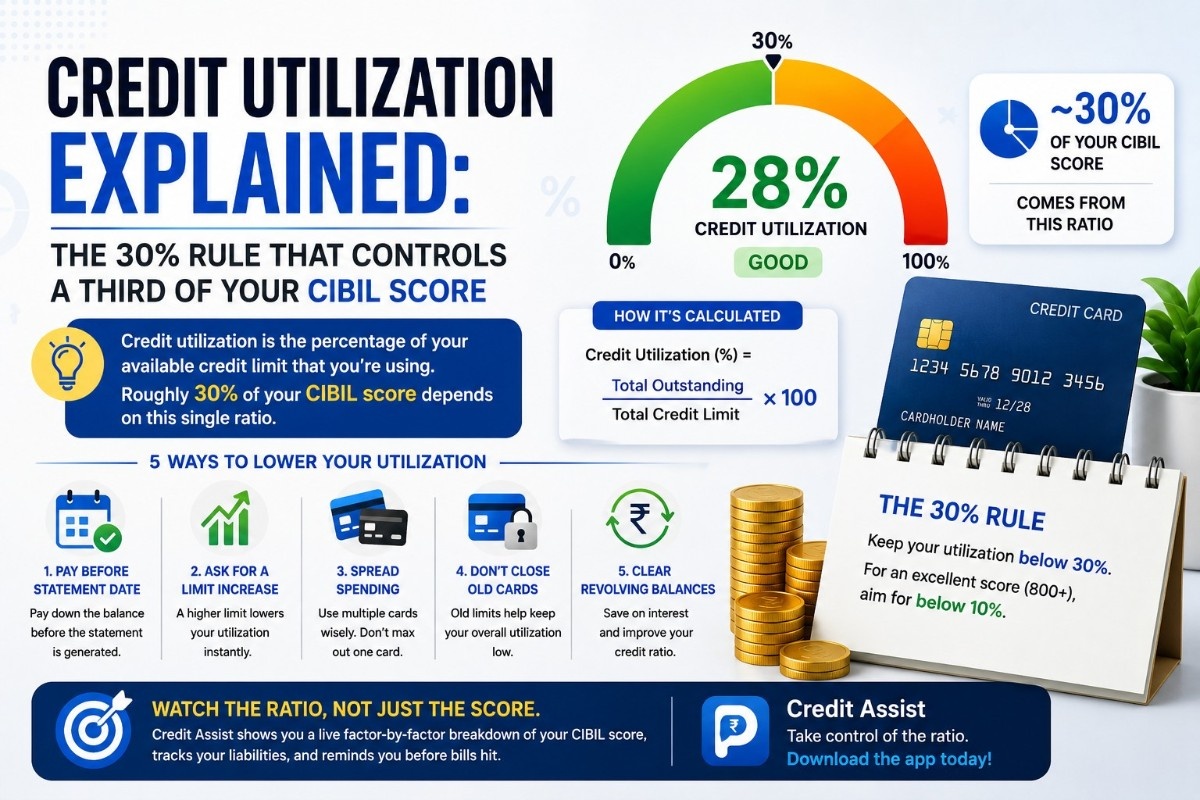
Roughly 30% of your score comes from this single ratio. And unlike payment history, which takes months to build, utilization can be improved in one billing cycle. It's the fastest lever most people never touch.
What credit utilization actually is
Credit utilization is the percentage of your available credit limit that you're using.
The formula is simple: (total outstanding on your cards ÷ total credit limit) × 100.
If your card has a Rs. 1 lakh limit and your statement balance is Rs. 80,000, your utilization is 80%. If you carry Rs. 20,000, it's 20%. If you have multiple cards, the bureaus look at both each card individually and the combined picture.
Why lenders care so much
Think about what a high ratio signals. Someone consistently using 85% of every limit they've been given is, statistically, someone living close to the edge, and people living close to the edge miss payments when anything goes wrong. Lenders don't know your life; they know your patterns. High utilization is the pattern of financial strain, so the scoring models punish it.
Low utilization signals the opposite: you have access to credit and the discipline not to lean on all of it. That's exactly who banks want to lend to.
The 30% line (and the 10% line above it)
The standard guidance: keep utilization below 30% of your limit. On a Rs. 1 lakh limit, that means keeping the balance under Rs. 30,000. This is the threshold below which the ratio stops actively hurting you.
But there's a second, less-advertised line: for an excellent score of 800+, aim below 10%. The top scorers aren't at 29%; they're at 4–8%. If you're optimizing for the best rates on a future home loan, single digits is the target.
One clarification people miss: 30% is a ceiling, not a budget. You don't need to use 30% to build credit. Small, regular usage (even 5%) paid in full each month builds history just fine.
The trap: paying in full but still scoring badly
Here's the scenario that confuses everyone. You spend Rs. 70,000 a month on a Rs. 1 lakh limit card, and you pay the bill in full every single time. Zero interest paid, perfect payment record. And your score still suffers. Why?
Because the bureau usually sees your statement balance, the amount on the bill when it's generated. If your statement reads Rs. 70,000, your reported utilization is 70%, regardless of the fact that you paid it three days later. Paying in full protects you from interest and late marks, but the snapshot the bureau receives is taken before your payment.
The fix is timing: pay down the balance before the statement generates, so the snapshot itself is small.
Five ways to lower your utilization
1. Pay before the statement date, not just the due date. As above. A mid-cycle payment shrinks the reported number. This is the closest thing to a legitimate quick trick in the entire credit system.
2. Ask for a limit increase. If your bank raises your limit from Rs. 1 lakh to Rs. 2 lakh and your spending stays at Rs. 30,000, your utilization just fell from 30% to 15% without any change in behaviour. Banks grant these routinely to customers with decent repayment records. One caution: this only works if the higher limit doesn't tempt higher spending.
3. Spread spending across cards. 40% on one card scores worse than 20% on each of two. If you already hold multiple cards, balance the load rather than maxing your favourite.
4. Don't close old cards. Every limit you close shrinks the denominator of your ratio. That old zero-annual-fee card you never use is silently doing you a favour just by existing. Keep it alive with one small recurring charge.
5. Clear lingering balances first. If you're carrying revolving debt across cards, you're paying 36–42% annual interest and wrecking your ratio simultaneously. Attacking card balances is the rare move that saves money and lifts your score at the same time.
How fast does it work?
Fast, by credit standards. Utilization has no memory in most scoring models: the score reacts to the current reported ratio, not your ratio from last year. Drop from 75% to 25% and you can see movement in the next reporting cycle. With Indian lenders now reporting at least every 15 days under RBI's rules, that can mean visible improvement within a month.
People fixated on payment history often overlook this. Payment sins take months to fade. Utilization sins vanish as soon as the balance does.
Watch the ratio, not just the score
The annoying part of managing utilization is that it moves every month with your spending, and most people have no idea what their reported ratio even is.
That's a visibility problem, and it's fixable. Credit Assist's score breakdown shows exactly how much of your score each factor is contributing, including utilization, and the asset and liability tracker keeps your balances and limits in one view. When you can see the ratio, keeping it under 30% stops being a guessing game and becomes a habit.
One number, one line to stay under. Of all the things your CIBIL score asks of you, this is the easiest to control, starting with your very next statement.
Credit Assist shows you a live factor-by-factor breakdown of your CIBIL score, tracks your liabilities, and reminds you before bills hit. Download the app and take control of the ratio.
Frequently Asked Questions
What is a good credit utilization ratio for a healthy CIBIL score?
Does paying my credit card bill in full automatically lower my credit utilization?
How quickly can reducing credit utilization improve my CIBIL score?
About the Author
Himanshu Mishra
@himanshu
View all posts →