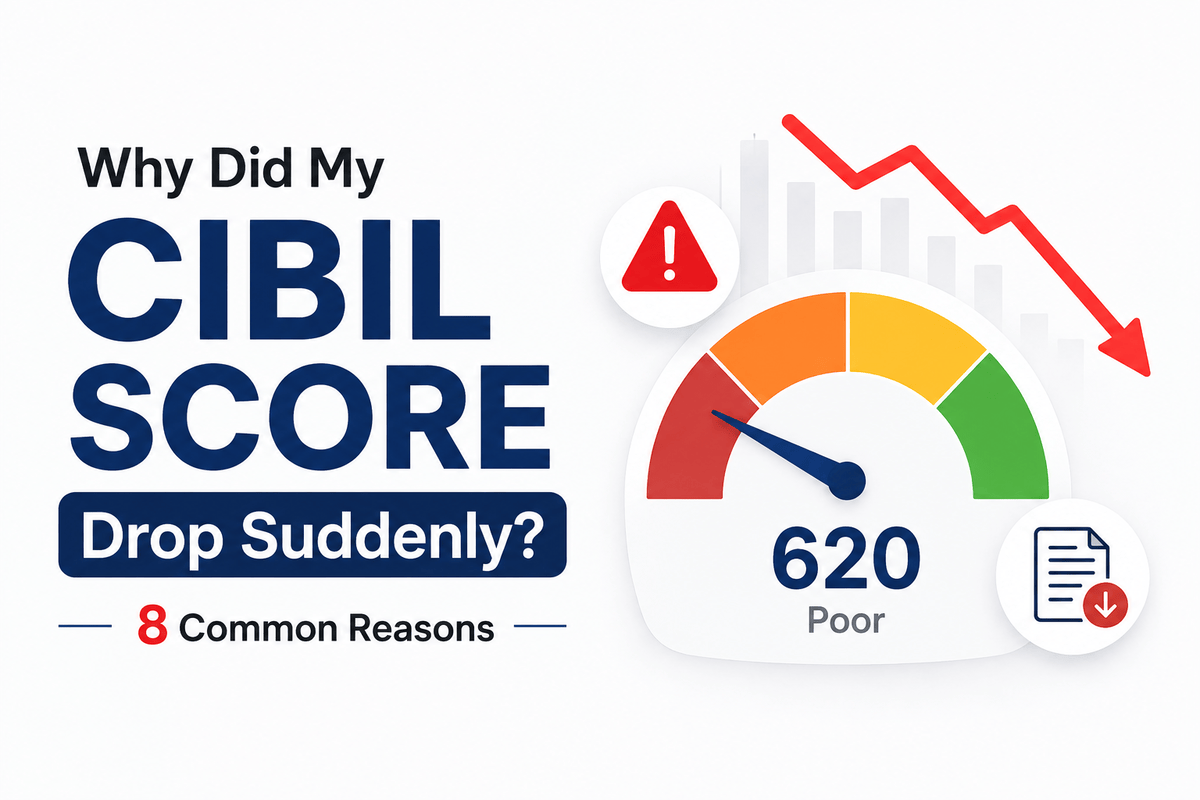
Why Did My CIBIL Score Drop Suddenly? 8 Common Reasons
❤️ Spread the Love
A sudden drop in your CIBIL score usually happens because of higher credit card usage, a new loan application, a missed payment, lender reporting errors, or changes in your credit accounts. Most score drops are temporary once the underlying issue is fixed. This guide explains the eight most common reasons a CIBIL score decreased, how to check which one applies to you, and what to do next.
Is It a Real Drop or a Normal Change?
A small drop of a few points is usually normal CIBIL score fluctuation, not a problem. Lenders now update your data with the bureaus at least once every 15 days under RBI rules, so your score changes often as your balances and payments are reported. A fall of 30 to 50 points is the kind that is worth checking.
So before you worry, look at how big the drop is. A small change that corrects itself the next month needs no action. A large or lasting drop means something on your report has changed, and the sections below will help you find it.
8 Reasons Your CIBIL Score Dropped Suddenly
Most sudden drops come down to one of the reasons below. Read them in order, because the first two explain most cases where a CIBIL score dropped without any reason you could see.
1. Credit Utilisation:
Credit utilisation is the share of your card limit that you are using. A credit utilisation spike is the most common answer to "why did my credit score drop", and it lowers your score even when you have paid every bill.
The reason is timing. The bureau usually sees your statement balance, which is the amount on your bill on the day it is generated. If you spend ₹70,000 on a card with a ₹1 lakh limit, your reported usage is 70%, even if you pay the full amount a few days later. The score reacts to that figure. To avoid this, pay the balance down before the statement date, so the amount reported is small. We explain the full method in our guide to the 30% credit utilisation rule.
2. Applied for New Credit:
Every time you apply for a loan or card, the lender checks your report. This is called a hard enquiry, and a hard enquiry score drop of a few points is normal for a single application.
The problem starts when there are many enquiries in a short time. Applying to several lenders within a few weeks suggests you are short of funds and looking for credit everywhere, and the score treats that as a risk. If you applied in more than one place recently, that is a likely cause. Space out your applications and wait a few months after a rejection before you try again.
3. Late Payment:
Payment history is the most important part of your score, so even one late mark has a strong effect. Sometimes you know a due date was missed. Other times the payment left your account on time but was recorded late by the lender.
Check the Days Past Due (DPD) section of your report for each account. If a month you paid on time shows anything other than "000" or "STD", it is worth raising a dispute. Our post on the CIBIL report errors that hurt your score explains how to do this.
4. Closed an Old Credit Card:
Closing a card can lower your score, which surprises many people. It happens for two reasons. Your older accounts add to the length of your credit history, so closing an old card can shorten that history. Closing a card also removes its limit from your total available credit, which pushes up your utilisation on the cards you keep.
If your score fell soon after you closed a card, that is the likely cause. In future, keep old cards that have no annual fee open and active with one small monthly purchase.
5. A Loan was Settled or Written Off:
If you recently closed a loan by paying less than the full amount, the lender may have marked it as "Settled" instead of "Closed". That single word can lower your score by a wide margin. A "Written-Off" tag, which means the lender stopped trying to recover the money, has an even stronger effect.
This can also explain a score drop after paying a loan, if the payment was recorded as a settlement rather than a full closure. If a settled tag is the problem, our guide on how to remove settled status from your CIBIL report covers the correct way to fix it.
6. An Account that is Not Yours Appeared On Your Report:
Credit reports are built from data sent by many lenders, and mistakes happen. A person with a name similar to yours, or a wrong PAN entry, can have their loan added to your report. If they miss a payment, your score takes the damage for a loan you never took.
Look through the accounts section for any lender you have never used. An unknown account is worth acting on quickly, because it can also be a sign of identity theft.
7. Your Credit Limit Was Lowered:
Sometimes a bank reduces your credit limit, often on a card you rarely use. You did nothing wrong, but the effect is real. A lower limit means the same spending now uses a bigger share of it, so your utilisation rises and your score falls. Compare your current limits with your recent statements. If a limit has dropped, that is your answer.
8. The Lender Made a Reporting Mistake:
Lenders make other reporting errors too. A closed loan may still show as active with a balance, an overdue amount may be wrong, or an old debt may not have been removed. Each mistake sits on your report and costs you points until you find it. The good news is that correcting a real error is the fastest way to recover, sometimes within 30 days.
How to Find The Exact Cause?
Once you know the possible reasons, the next step is to match one to your report. Download your full CIBIL report and read it section by section. Accounts and balances: check your card balances and limits for a utilisation increase or a lower limit.
DPD section: look for late marks in months you paid on time.
Enquiries: count recent hard enquiries and note any you did not make.
Account status: watch for new "Settled" or "Written-Off" tags, or loans wrongly shown as active.
Unknown accounts: any lender you do not recognise.
A full report runs to many pages of tables, so the entry that lowered your score is easy to miss. Credit Assist is built to make this simpler. It shows a clear, factor-by-factor breakdown of your score, so the cause stands out instead of hiding in the numbers.
How to Recover After a Sudden Drop?
Recovery depends on what caused the drop. Some issues, like high credit utilisation or reporting errors, can improve quickly, while others require consistent on-time payments and responsible credit usage over time.
Quick to recover: Utilisation has little lasting effect, so paying a card down can lift your score in the next cycle. A genuine error, once disputed and corrected, can also improve your score within about 30 days.
Slower to recover: Late payments, settlements, and write-offs are correct negative records, and no honest service can delete them. Here the only real fix is time and steady habits. Pay every bill on time, keep utilisation below 30%, and avoid new applications for a while. If anyone offers to remove correct negative information for a fee, it is a scam.
If your credit history is short and the drop removed most of it, rebuilding with the right product helps. Our guide on building your CIBIL score from scratch explains how to do this safely.
When a Sudden Drop is a Warning Sign?
Most drops are ordinary, but a few point to fraud. If you see an account you never opened, or enquiries from lenders you never approached, treat it as urgent, because someone may be using your details to apply for credit. Raise a dispute on the bureau's website straight away, report the account, and keep checking your report until it is fixed. Fraud is much easier to stop early than to undo later.
Conclusion:
A sudden drop in your CIBIL score is worrying, but it is rarely a mystery and rarely permanent. In most cases the cause is high utilisation, a new enquiry, or a reporting error, and each of these has a clear fix. Download your report, match the drop to one of the eight reasons above, and act on that specific cause.
Frequently Asked Questions
Why did my CIBIL score drop when I paid on time?
Can a CIBIL score drop without any reason?
How much does a hard enquiry lower the CIBIL score?
How long does it take to recover a sudden drop?
About the Author
Khushi Mishra
@khushi.mishra@paymeindia.in
View all posts →