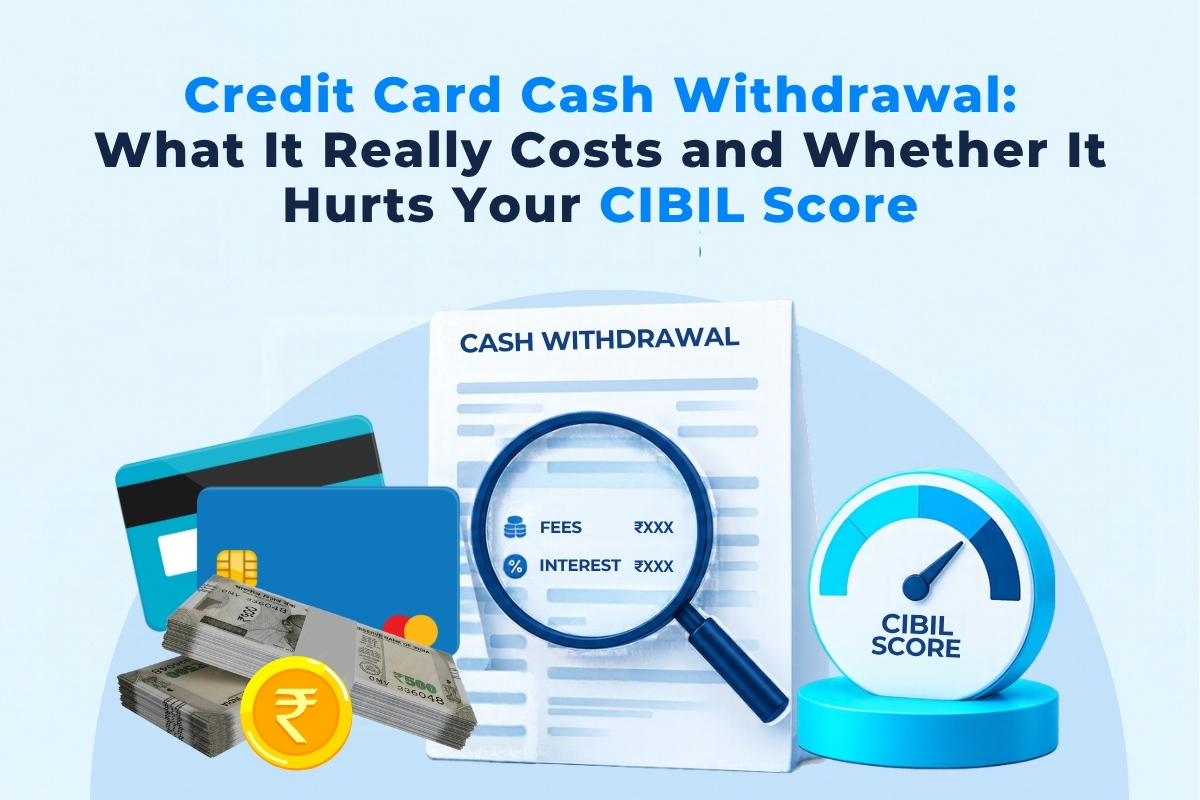
Credit Card Cash Withdrawal: What It Really Costs and Whether It Hurts Your CIBIL Score
❤️ Spread the Love
Withdrawing cash from a credit card can help during an emergency, but it is one of the more expensive ways to access money. You may pay a cash advance fee, GST on that fee and interest from the withdrawal date. The transaction itself is not a documented CIBIL score factor, but the resulting outstanding balance, credit utilisation and any missed payment can affect your credit profile. Before using your card at an ATM, understand the full cost and how to manage repayment.
Does Cash Withdrawal from a Credit Card Affect Your CIBIL Score?
A cash withdrawal is not listed by TransUnion CIBIL as a separate score factor, but the resulting balance can affect your credit profile through credit utilisation and repayment behaviour. The key distinction is between taking cash and failing to manage the amount you owe.
TransUnion CIBIL identifies factors such as payment history, credit utilisation, credit history and enquiries when explaining credit scores. A cash advance adds to your credit card balance, which can increase the proportion of your available credit that you use. If the outstanding amount remains high, your credit utilisation may rise.
The withdrawal may also become more costly if you cannot repay it promptly. Interest accumulates from the transaction date under the issuer’s terms, and an unpaid bill can lead to past-due reporting and charges.
Keep these three effects separate:
The cash withdrawal: It is a transaction, not a documented standalone CIBIL score factor.
The outstanding balance: It contributes to the amount of credit you are using and may affect utilisation.
The repayment record: Missing payments or allowing the account to remain past due can harm your credit profile.
This is why the answer to “does cash withdrawal from credit card affect CIBIL score?” is not simply yes or no. The withdrawal has an immediate financial cost, while the credit-score impact depends on the resulting account position and repayment behaviour.
What Are Credit Card Cash Advance Charges in India?
A credit card cash advance generally attracts a transaction fee, applicable GST on that fee and finance charges from the date of withdrawal. The exact fee and interest rate depend on the card issuer and the terms applicable to your card.
For a worked example, SBI Card’s published terms for unsecured cards list a domestic ATM cash advance fee of 2.5% of the withdrawal amount or ₹500, whichever is higher. Its published finance charge is 3.75% per month, equivalent to 45% per annum. The issuer states that finance charges apply from the date of withdrawal until full payment.
Here is what each charge means:
Cash advance fee: A transaction fee charged for withdrawing cash using the credit card.
GST: Applicable tax on the fee and other taxable charges.
Finance charge: Interest that accumulates on the cash advance according to the issuer’s terms.
Late payment charges: These may apply if the account becomes past due, subject to the card’s terms and applicable regulations.
Do not assume that the fee is the full cost of the transaction. The interest can be the larger expense if you take time to repay the amount. Check your card’s Most Important Terms and Conditions (MITC) and fee schedule before withdrawing cash.
How Much Does a ₹20,000 Credit Card Cash Withdrawal Actually Cost?
For a ₹20,000 cash advance on an eligible SBI Card unsecured card, the illustrative cost for 30 days is ₹1,340 before any additional charges, assuming the balance remains unpaid throughout the period. This includes the cash advance fee, GST on that fee and one month of finance charges.
The calculation uses the issuer’s published fee of 2.5% or ₹500, whichever is higher, and its monthly finance charge of 3.75%. The example assumes no repayments, other transactions, additional fees or changes in the applicable rate.
This is an illustration, not a guaranteed bill amount. The actual finance charge may depend on the issuer’s calculation method, transaction dates, payments, applicable taxes and card terms. If the balance remains unpaid for longer, the interest cost can rise further.
The important point is that a ₹20,000 withdrawal does not necessarily cost only ₹500. Once GST and finance charges are included, the total cost can be considerably higher.
Credit Card Purchase vs Cash Withdrawal: What Is the Difference?
A normal purchase may qualify for an interest-free period if you meet the card’s terms, while a cash advance generally has no interest-free period. This makes withdrawing cash more expensive than making an equivalent eligible purchase and paying the bill in full by its due date.
Cost or feature | Eligible card purchase | Cash advance |
Transaction fee | Usually no cash advance fee | Cash advance fee applies |
Interest-free period | May apply if conditions are met | Generally not available |
When interest starts | Depends on the billing terms and whether the interest-free period applies | From the withdrawal date under the issuer’s terms |
GST | Depends on applicable charges | GST applies to the taxable cash advance fee |
Credit utilisation | Purchase increases the outstanding balance | Cash advance increases the outstanding balance |
For example, suppose you spend ₹20,000 on an eligible purchase and pay the full statement balance by the due date. If the interest-free period applies and you meet the card’s conditions, you may not incur interest on that purchase.
If you withdraw ₹20,000 as cash on the same day, the cash advance fee and interest begin to apply under the issuer’s terms. The two transactions may therefore have very different costs even though the amounts are identical.
Remember that the interest-free period for purchases may also be suspended when you carry an unpaid balance from a previous billing cycle. Always check the applicable MITC rather than assuming every card transaction qualifies for interest-free credit.
What Is the Difference Between a Cash Withdrawal Limit and a Credit Limit?
Your credit limit is the maximum revolving credit available on the card, while the cash withdrawal limit is the smaller amount the issuer permits you to withdraw as cash. The cash limit is generally a sub-limit within the overall credit limit, not an additional borrowing facility.
Consider a card with a total credit limit of ₹1,00,000 and a cash withdrawal limit of ₹20,000. If you withdraw the full ₹20,000 and have no other outstanding balance, the withdrawal represents 20% of the overall credit limit. It does not mean you have used 100% of your total credit limit.
However, your available credit reduces by the amount of the withdrawal, and the cash advance fee and interest can add to the amount you owe. Your actual reported balance and utilisation depend on the account details reported by the issuer.
For credit health, monitor the overall outstanding balance rather than looking only at the cash sub-limit. TransUnion CIBIL describes lower credit utilisation as a healthy credit habit, and its educational guidance has discussed keeping overall card spending around or below 30% of the available limit as a useful benchmark—not a guaranteed scoring threshold.
What If You Cannot Pay the Credit Card Bill After a Cash Withdrawal?
If you cannot repay the cash advance immediately, pay as much as you reasonably can and contact the issuer about the outstanding amount. Interest continues according to the card terms, and an unpaid bill may become past due if it remains unpaid beyond the applicable period.
The Reserve Bank of India’s credit card directions provide that an issuer should report an account as past due to credit information companies, or levy applicable penal charges, only when the account remains past due for more than three days. The number of days past due is still computed from the payment due date shown on the statement. This is not an extra interest-free period; finance charges on a cash advance may already be accumulating.
If repayment is difficult, take these steps:
Check the statement: Confirm the cash advance, fee, interest and total amount due.
Pay promptly: Repay as much as possible without ignoring essential expenses. Paying the full amount is generally the best way to stop further finance charges on the cleared balance.
Contact the issuer: Ask about available repayment options and the cost of carrying the remaining balance.
Avoid additional cash advances: A second withdrawal can add another fee and increase the outstanding amount.
Track the due date: Do not rely on the minimum amount due as a long-term repayment strategy. Interest can make the remaining balance expensive.
If the payment has already been delayed, review your credit report after the issuer’s reporting cycle. If you find inaccurate information, contact the issuer and use the bureau’s official dispute process.
What Are the Alternatives to a Credit Card Cash Advance?
Before taking a cash advance, compare alternatives based on total cost, repayment time and eligibility. A lower advertised rate does not automatically make another product suitable if it includes processing fees, penalties or repayment obligations you cannot meet.
Depending on the urgency and amount required, consider:
Savings or an emergency fund: If accessible, this avoids borrowing costs and interest.
A bank overdraft or pre-approved loan: Compare the interest rate, fees, tenure and total repayment with the cash advance cost.
A personal loan: This may suit a larger planned expense, but approval depends on eligibility and the cost may still be high.
A secure credit card or secured credit card: This is generally intended to help establish or use credit against a deposit, not to provide a cheaper cash withdrawal. Check the product’s terms and whether it meets your actual needs.
Do not take a new loan simply to pay an existing card bill without comparing the total cost. If you are already struggling with repayments, adding another credit obligation can make the problem harder to manage.
What Should You Do If You Have Already Withdrawn Cash?
If you have already taken a cash advance, focus on reducing the outstanding balance, limiting additional charges and making the next payment on time. You cannot reverse the cost already incurred simply by avoiding further withdrawals, but you can prevent the balance from becoming more expensive.
Use this practical sequence:
Check the transaction date, cash advance fee, GST and interest shown on your statement.
Confirm the applicable monthly rate and whether any additional charges apply.
Repay the balance as early as possible, subject to your issuer’s payment allocation rules.
Avoid new withdrawals until the existing balance is cleared.
Check your total credit utilisation and upcoming statement due date.
Review your credit report if a payment is missed or account information appears incorrect.
A single cash advance does not automatically mean your credit score will fall. The more immediate concern is the cost of borrowing and whether the balance affects your utilisation or becomes overdue. Staying current on payments and keeping the overall balance manageable can help protect your credit profile.
How Credit Assist Can Help You Monitor Credit Health
Credit Assist can help you stay informed about your credit profile and understand the factors that may need attention. Monitoring is useful after a cash advance because it helps you review your broader credit position, although it cannot remove valid charges, change an issuer’s terms or guarantee a particular score.
A Credit builder approach starts with manageable borrowing, timely repayments and regular review of your credit report. If you are trying to Improve Your Credit, focus on paying bills on time, keeping outstanding balances under control and checking for inaccurate entries. A score drop can have several causes, so review the underlying report instead of assuming the cash withdrawal alone caused it.
Conclusion
A credit card cash advance offers quick access to cash, but the fee, GST and day-one interest can make it expensive. Before withdrawing, compare alternatives and check your issuer’s MITC. If you have already withdrawn cash, prioritise repayment and keep your account current.
Frequently Asked Questions
Does withdrawing cash from a credit card affect my CIBIL score?
What is the cash advance fee on a credit card in India?
Is there an interest-free period on a credit card cash withdrawal?
What is the difference between a credit limit and a cash withdrawal limit?
Can I avoid paying a cash advance fee?
About the Author
Khushi Mishra
@khushi.mishra@paymeindia.in
View all posts →