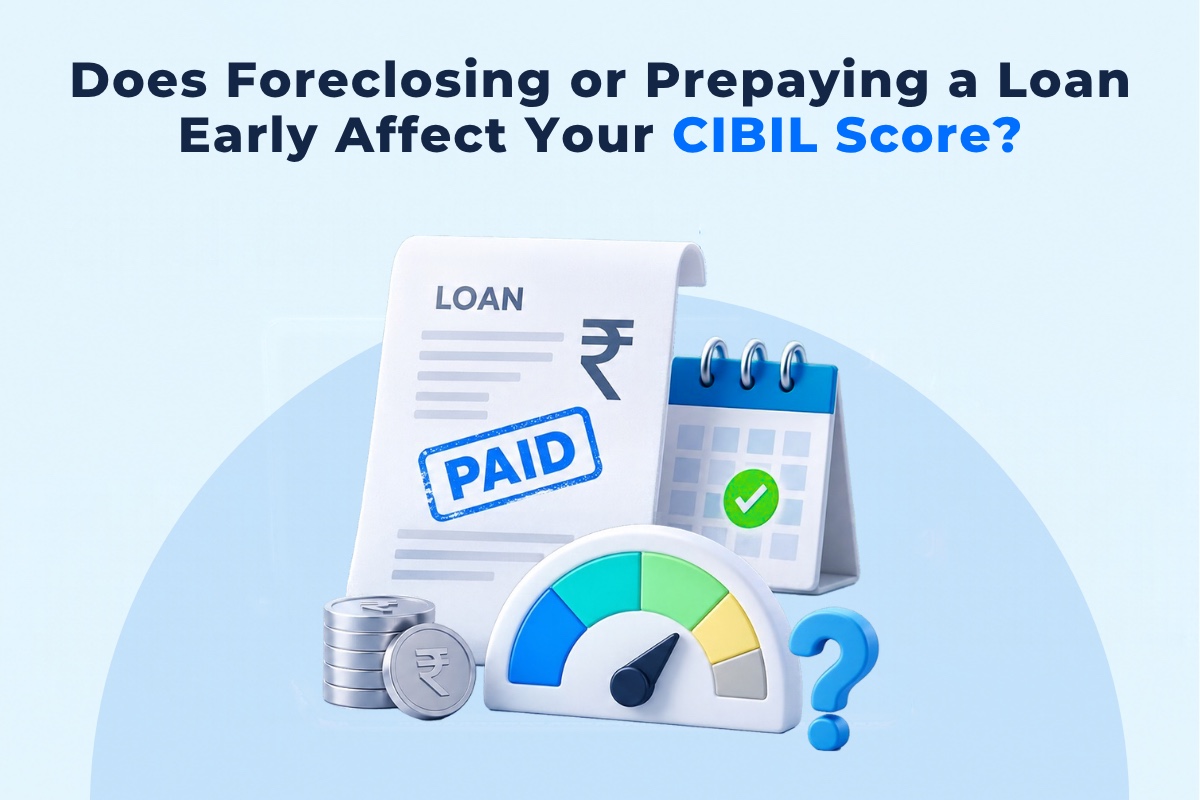
Does foreclosing a loan affect your CIBIL score
❤️ Spread the Love
Closing a loan early does not automatically damage your credit score. The effect depends on your repayment history, the other credit accounts you hold and how the lender updates your credit report. Before making a part-prepayment or full foreclosure, check the applicable charges under the RBI’s 2025 directions, your outstanding balance and the documents you must collect after closure.
What happens to your credit report when you foreclose a loan?
When you foreclose a loan, you repay the outstanding amount before the scheduled end of the loan tenure. The lender updates the account after processing the closure, but the account’s repayment history does not simply disappear.
Two situations need to be distinguished:
Part-prepayment: You repay a portion of the outstanding principal. The loan remains active, and the balance reduces according to the lender’s updated records.
Full foreclosure: You repay the entire amount due before the original tenure ends. The lender processes the closure and reports the account status to the credit bureau.
Your credit report contains information such as account status, outstanding balance and repayment history. A properly closed loan is not the same as a loan that has been settled for less than the amount due.
The key point is that early repayment changes the status or balance of an account; it does not erase the history of how you managed that loan.
What is the difference between part-prepayment and full foreclosure?
Part-prepayment reduces your loan balance while keeping the account open, whereas full foreclosure pays off the entire outstanding amount and ends the loan. The right option depends on your cash reserves, interest savings and future borrowing needs.
Credit or loan detail | Part-prepayment | Full foreclosure |
Outstanding balance | Reduces | Becomes nil after the lender processes full repayment |
Loan status | Usually remains active | Should reflect closure once processed |
Future EMIs | May reduce in amount or tenure, depending on your lender’s terms and your choice | Stop after closure is completed |
Repayment history | Remains associated with the account | Remains part of the credit history |
Credit score effect | No guaranteed increase or decrease | No guaranteed increase or decrease |
Best suited for | Borrowers seeking to reduce interest while retaining the loan | Borrowers who can repay the full amount and retain sufficient savings |
Before choosing either option, ask the lender for a revised repayment schedule or a foreclosure statement. This helps you compare the interest saved with any applicable charges and the money you would have left for emergencies.
Can your lender charge foreclosure fees under the RBI rules introduced in 2025?
The RBI’s Pre-payment Charges on Loans Directions, 2025 took effect for loans sanctioned or renewed on or after 1 January 2026. They prohibit prepayment charges on specified floating-rate loans, but the exact protection depends on the loan’s purpose, rate type and, for certain business loans, the lender category and sanctioned amount.
When are foreclosure charges not permitted?
For eligible floating-rate loans, the RBI rules provide protection against prepayment charges, including when the borrower repays only part of the loan. The directions also specify that covered borrowers cannot be subjected to a minimum lock-in period before prepaying.
The main rules are:
Individual borrowing for a non-business purpose: Regulated lenders cannot levy prepayment charges on floating-rate loans granted to individuals for purposes other than business.
Business loans to individuals and micro and small enterprises (MSEs): Exemptions depend on the regulated lender’s category and, for certain categories, whether the sanctioned amount or limit is up to ₹50 lakh.
Part-prepayment and full foreclosure: Where the directions apply, the protection covers both partial and full repayment, irrespective of the source of funds.
Dual-rate loans: For loans that switch between fixed and floating interest rates, applicability depends on whether the loan is on a floating rate at the time of prepayment.
These directions do not mean that every loan, regardless of its sanction date and terms, is automatically free from charges. Check the sanction letter, loan agreement and Key Facts Statement (KFS), where applicable, before relying on an exemption.
Is a foreclosure charge lawful in your case?
Use this table as an initial guide, then confirm your specific loan terms with the lender. It summarises the RBI directions for loans sanctioned or renewed from 1 January 2026; other cases may be governed by existing instructions or the lender’s approved policy.
Loan situation | What the RBI directions say |
Floating-rate personal loan for a non-business purpose to an individual | No prepayment charge under the directions |
Floating-rate business loan to an individual or MSE from a commercial bank other than a small finance bank, regional rural bank or local area bank | No prepayment charge under the specified lender-category rule |
Floating-rate business loan from an NBFC-Upper Layer or an All India Financial Institution to an individual or MSE | No prepayment charge under the specified rule |
Floating-rate business loan from a small finance bank, regional rural bank, specified cooperative bank or NBFC-Middle Layer, with a sanctioned amount or limit up to ₹50 lakh | No prepayment charge under the specified rule |
Fixed-rate loan or a loan outside the covered categories | Check the applicable RBI instructions and disclosed lender policy; do not assume an automatic exemption |
Dual-rate loan | The applicable rule depends on whether the loan is floating-rate when prepayment occurs |
If a lender proposes a charge, ask for the contractual clause, the calculation and the regulatory basis in writing. A charge that was not disclosed as required by the RBI directions cannot simply be introduced at foreclosure.
Does loan foreclosure affect your CIBIL score?
Foreclosing a loan does not automatically lower or increase your credit score. Credit bureaus assess multiple aspects of your credit history, including repayment behaviour and credit mix, so the effect depends on your wider profile rather than the closure alone.
TransUnion CIBIL explains that credit mix contributes to the score calculation, but it does not outweigh timely repayments or responsible credit use. This is why claims that foreclosure always improves a score—or always causes a decline—should be treated cautiously.
Consider the following factors:
Repayment history: A record of paying EMIs on time remains relevant after the loan is closed.
Credit mix: Closing an instalment loan changes the combination of credit accounts in your profile, but this does not guarantee a particular score movement.
Active accounts: If the foreclosed loan was your only active credit account, you may have less current account activity reflected in your profile.
Other borrowing: Credit card balances, existing loans and repayment behaviour continue to matter.
There is no reliable universal number of points that every borrower gains or loses after foreclosure. Review your own report rather than relying on a fixed score prediction.
Can foreclosing your only active loan affect a thin credit file?
A thin credit file contains limited information about a person’s borrowing and repayment behaviour. If you close your only active loan, your report may have less current account activity, but that alone does not establish that your score will fall.
For someone planning to apply for a home loan or another major credit facility, the practical question is whether early repayment leaves enough accessible savings and whether the rest of the credit profile demonstrates responsible use. Avoid keeping an expensive loan open solely to maintain an active account.
If you have credit cards or other credit facilities, continue managing them within your budget and pay on time. A Credit builder approach should focus on sustainable repayment habits rather than borrowing money unnecessarily just to maintain a particular mix of accounts.
How long does loan foreclosure take to appear on your credit report?
A lender’s reporting cycle means the closure may not appear immediately, even after you have paid the full amount. TransUnion CIBIL states that credit institutions generally submit data within 30–45 days, so checking the report too soon may show the old balance or account status.
After foreclosure, follow these steps:
Obtain the lender’s confirmation that the full amount due has been received.
Collect the foreclosure statement and No Objection Certificate (NOC), where issued.
Ask the lender to confirm how the account closure will be reported to the credit bureau.
Allow the usual reporting window of around 30–45 days before checking the report again.
If the status or balance remains incorrect, contact the lender and raise a dispute with the credit bureau as appropriate.
If the account still appears active shortly after payment, it does not automatically mean the lender has failed to close it. Check the report’s Date Reported field and allow time for the next update. CIBIL advises that a dispute may be appropriate when the relevant reporting date is more than two months old and the payment is still not reflected.Our guide on a loan closed but showing active on CIBIL walks through the fix.
What should you collect after closing a loan?
Keep written evidence of repayment and closure so you can resolve future discrepancies with the lender or credit bureau. The exact documents depend on the loan, but you should not rely only on a payment receipt or a verbal confirmation.
Use this checklist:
Foreclosure statement: Shows the amount payable to close the loan, including any valid charges.
Payment receipt: Confirms the amount and date of payment.
No Objection Certificate (NOC) or closure letter: Ask the lender for written confirmation that the loan has been fully repaid and closed.
Credit-report update confirmation: Request written confirmation of the account status that the lender will report.
Original property documents, where applicable: For loans covered by the RBI’s document-release directions, lenders must release original movable or immovable property documents and remove registered charges within 30 days of full repayment or settlement. The applicable directions provide compensation of ₹5,000 per day for delay, subject to their terms.
Do not assume that the document-release compensation applies to every unsecured loan or every type of document. Check whether the relevant RBI direction applies to your loan.
Should you choose part-prepayment or full foreclosure?
Part-prepayment can reduce the outstanding principal while preserving your emergency funds, whereas full foreclosure removes the remaining loan obligation but uses more cash at once. Compare the total interest saved, any applicable charge, your remaining savings and your near-term financial commitments before deciding.
Part-prepayment may suit you if you want to reduce the tenure or EMI without exhausting your savings. Ask the lender whether the prepayment will reduce the EMI or shorten the tenure, because the outcome depends on the lender’s process and your selected option.
Full foreclosure may be suitable when you have enough money to clear the loan and still cover essential expenses and emergencies. It can also simplify monthly commitments, but it should not be treated as a guaranteed way to raise your credit score.
If you are planning to Improve Your Credit, prioritise timely repayments, sensible borrowing and regular checks of your credit report. Do not make a decision based only on the fear of a possible score drop.
How Credit Assist can help you monitor your credit health
After closing a loan, reviewing your credit profile can help you check whether the account details have been updated correctly. Credit Assist can help you understand your credit health and identify the areas of your profile that may need attention as you plan future borrowing.
Use your credit report to verify the closed account, outstanding balance and repayment history. If you notice an error, contact the lender and follow the bureau’s dispute process instead of assuming that the score itself explains the issue. You do not need to take a new loan or rely on products such as secured credit cards simply because one account has been closed.
Conclusion:
Foreclosure is a repayment decision, not a guaranteed credit-score strategy. Check the RBI rules that apply to your loan, compare the financial cost of early repayment, collect written closure documents and verify the credit-report update before considering the matter complete.
Frequently Asked Questions
Does foreclosing a loan lower my CIBIL score?
Can my lender charge a foreclosure fee?
How soon does foreclosure reflect in my credit report?
Is foreclosure the same as loan settlement?
What is better: part-prepayment or full foreclosure?
What documents should I collect after foreclosing a loan?
About the Author
Khushi Mishra
@khushi.mishra@paymeindia.in
View all posts →