Why Does Your Credit Score Drop Even When You Pay EMIs on Time?
❤️ Spread the Love
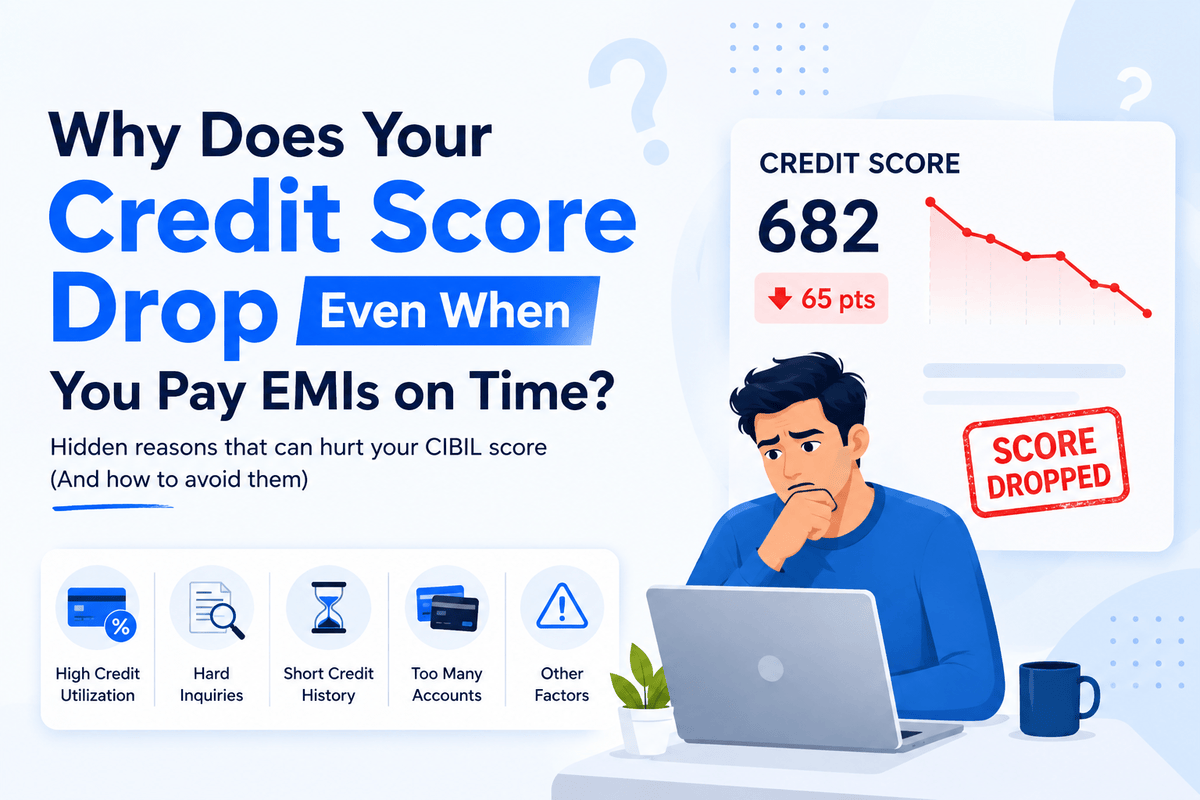
Paying your EMIs on time is one of the most important credit habits, but it does not guarantee that your credit score will always increase. A credit score drop can happen because of higher credit utilisation, new enquiries, account changes or incorrect information on your credit report.
If your score has fallen despite making every EMI payment on time, the first step is to check what changed in your credit report.
Why Does Your Credit Score Drop Even When You Pay EMIs on Time?
Your credit score reflects more than your EMI repayment history. Credit utilisation, recent enquiries, account status, credit history and information reported by lenders can also affect your score.
Here are the most common reasons behind a credit score drop despite timely EMI payments.
High Credit Utilisation: Using a large portion of your available credit can affect your credit profile even when you pay the bill on time. For example, using ₹80,000 from a ₹1 lakh limit means your utilisation is 80%. If high utilisation is the issue, our guide on how to improve your credit score covers practical ways to manage your credit usage.
New Credit Enquiries: Applying for multiple loans or credit cards within a short period can create several hard enquiries on your credit report. These enquiries may affect your credit score even when your existing EMIs are fully paid.
Closing Old Credit Cards: Closing an old credit card reduces your available credit and can change your overall credit profile. The effect depends on your existing limits, accounts and credit history.
Loan Settlement: A loan marked “Settled” is different from one marked “Closed.” Settlement can negatively affect your credit profile because it indicates that the lender accepted less than the full outstanding amount.
Credit Report Errors: A wrongly reported late payment, outstanding balance or account status can affect your credit score even when you have paid your EMIs on time.
Closed Loan Showing Active: A repaid loan can remain visible as part of your credit history. However, if the account is incorrectly showing as active or has an outstanding balance, you should contact the lender for correction.
New Credit Information: Your credit report changes when lenders provide updated information. A new balance, enquiry, repayment record or account status can therefore cause your credit score to move.
Does Paying EMIs on Time Guarantee a Higher Credit Score?
No. Timely EMI payments are important, but your credit score considers your wider credit profile.
For example, you may pay every EMI on time while your credit card utilisation increases or several new enquiries appear on your report. Your repayment history remains positive, but other changes can still contribute to a credit score drop.
For a deeper explanation, read how credit scores are calculated in India and the factors that influence them.
How to Find Why Your Credit Score Dropped?
If your credit score drops, do not immediately apply for another loan or credit card. First, review your latest credit report and compare it with your previous information.
Start with these checks:
Check your payment history: Look for any incorrectly reported late or missed payment.
Review credit utilisation: Check whether your credit card balances have increased significantly.
Check recent enquiries: Look for new loan or credit-card enquiries that you do not recognise.
Review account status: Check whether recently closed or repaid loans are correctly reported.
Look for errors: Verify your balances, accounts and personal information.
This process helps you identify whether the credit score drop is linked to your own credit behaviour or an error in the information reported by a lender.
Can Credit Card Usage Lower Your Credit Score?
Yes. Credit card usage can affect your credit score, particularly when your reported balance represents a high proportion of your available limit.
Paying the full bill on time is still important, but it does not mean your reported utilisation was low during the reporting cycle.
This is also why understanding credit utilisation is important when managing a credit card.
Can Closing a Loan Lower Your Credit Score?
Closing a loan does not automatically mean your credit score will fall. However, changes to your credit accounts can affect your overall credit profile.
After repaying a loan, check that the account is correctly marked as closed and that the outstanding balance is shown as zero. If the information is incorrect, contact the lender and raise a dispute where necessary.
Can a Secured Credit Card Help After a Credit Score Drop?
A secured credit card can be useful for people who are new to credit or rebuilding their credit history, provided they use it responsibly.
Because it is backed by a fixed deposit, a secured card may be easier to access than some unsecured cards. Regular, timely payments and controlled usage can help build positive credit history.
Read our guide on secured credit cards to understand how they work and who they may suit.
What Should You Do After a Credit Score Drop?
The right action depends on the reason behind the change. Do not try to fix a credit score drop by taking unnecessary loans or applying for multiple cards.
Focus on the underlying issue:
Reason | What to check |
High utilisation | Reduce credit card balances |
New enquiries | Avoid unnecessary applications |
Reporting error | Contact the lender and dispute it |
Closed loan showing active | Request account correction |
Loan settlement | Check the reported account status |
New account | Verify whether you applied for it |
The objective is not to chase a particular number. It is to keep the information in your credit report accurate and maintain responsible credit behaviour.
How Credit Assist Can Help?
A credit score can change for several reasons, and looking at the number alone may not tell you what caused the change.
Credit Assist helps users understand their credit health, monitor important changes and make more informed credit decisions. Regular monitoring can help you identify unusual changes, reporting errors and areas that need attention before applying for new credit.
Conclusion:
Paying EMIs on time is important, but it is only one part of your credit profile. If your credit score drops, check utilisation, enquiries, account changes and reporting errors before assuming your EMI payments are the problem.
Frequently Asked Questions
Why did my credit score drop even though I paid my EMIs?
Can credit utilisation reduce my credit score?
Does checking my own credit score reduce it?
Can closing a credit card cause a credit score drop?
What should I check when my credit score suddenly drops?
About the Author
Khushi Mishra
@khushi.mishra@paymeindia.in
View all posts →