FOIR Full Form and How It Affects Loan Eligibility
❤️ Spread the Love
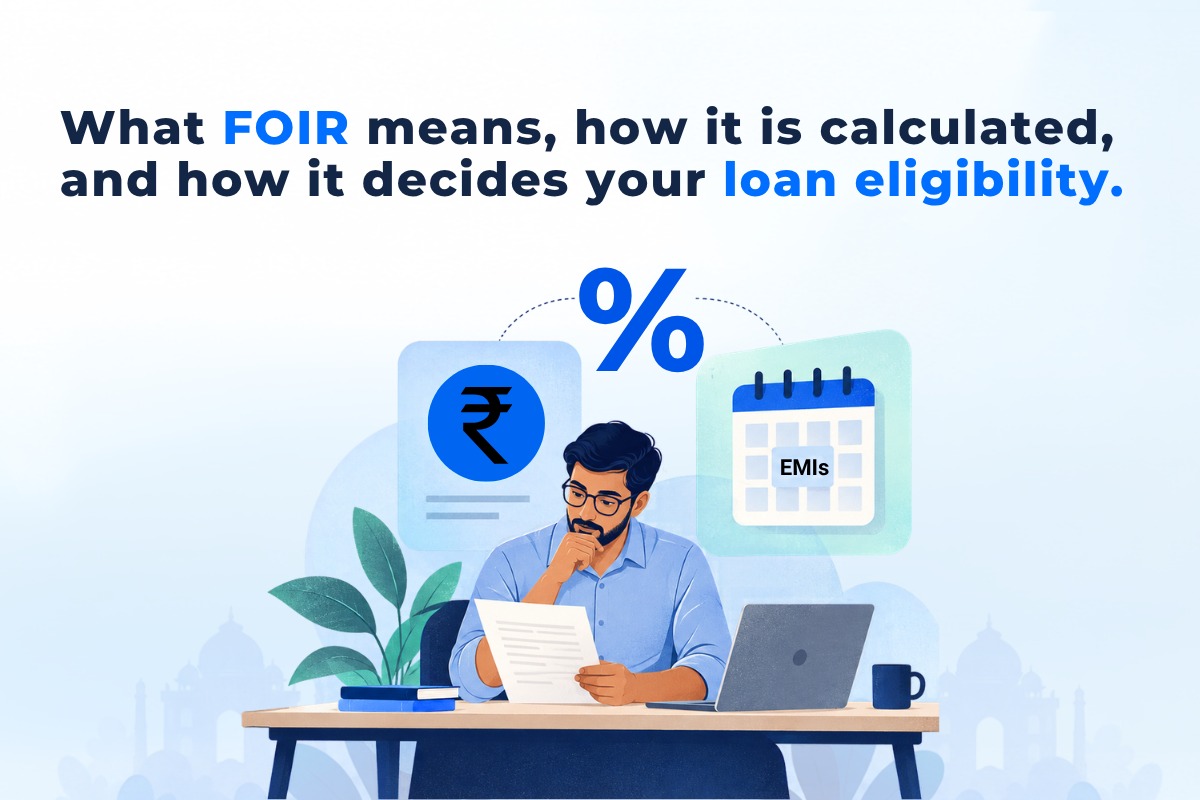
FOIR stands for Fixed Obligation to Income Ratio. It measures how much of your monthly income goes towards existing financial commitments and helps lenders assess whether you can afford another loan EMI. A high FOIR may reduce your eligible loan amount or lead to rejection, even if you have a good credit score.
What Is FOIR in Banking?
FOIR is a financial ratio used by banks and NBFCs to assess your repayment capacity. It compares your regular monthly financial obligations with your income to estimate how much room you have for another loan.
For example, if you earn ₹80,000 per month and already pay ₹35,000 towards eligible fixed obligations, a large part of your income is committed before you take on any new debt.
When you apply for a personal loan, home loan or another credit facility, the lender may calculate your FOIR to understand whether the proposed EMI fits your financial position. This makes FOIR an important part of loan eligibility, alongside your credit history, income stability and other lender-specific criteria.
How Is FOIR Calculated?
The FOIR calculation formula is:
FOIR = (Total Monthly Fixed Obligations ÷ Monthly Income) × 100
Lenders may use gross monthly income, net monthly income or another defined income measure. They may also differ in which obligations they include. Check the lender’s calculation method before treating your own estimate as final.
FOIR Calculation Example
Suppose you earn ₹80,000 per month and are applying for a personal loan with a proposed EMI of ₹10,000.
Particulars | Monthly Amount |
Monthly income | ₹80,000 |
Existing home loan EMI | ₹15,000 |
Existing personal loan EMI | ₹8,000 |
Credit-card obligation considered by lender | ₹2,000 |
Proposed loan EMI | ₹10,000 |
Total obligations | ₹35,000 |
Using these figures:
FOIR = (₹35,000 ÷ ₹80,000) × 100 = 43.75%
Your estimated FOIR is 43.75%. Whether this meets the lender’s requirement depends on its policy, the income basis it uses and the rest of your application.
This example also shows why you should include the proposed EMI when estimating FOIR for a personal loan. Calculating only your existing obligations can make your borrowing capacity look higher than it actually is.
What Is a Good FOIR for a Loan?
A FOIR of around 40% to 50% is commonly cited as a broad reference range, but there is no single ideal FOIR that applies to every bank, NBFC or loan product.
Some lenders may accept a higher ratio for applicants with stronger income or other favourable factors. Others may apply stricter limits depending on the loan type, income profile and internal risk assessment.
FOIR | What It May Indicate |
Below 30% | A relatively smaller share of income is committed |
30%–40% | Moderate fixed repayment commitments |
40%–50% | A significant share of income is committed |
Above 50% | Less income may be available for additional repayments |
These are illustrative interpretations, not official approval categories. A low FOIR does not guarantee loan approval, and a higher FOIR does not automatically mean rejection.
When assessing loan eligibility, lenders also consider whether your remaining income is sufficient for your regular living expenses and other financial needs.
How Does FOIR Affect Loan Eligibility?
FOIR helps lenders assess how much additional repayment your income can support. A high ratio may affect the amount you qualify for, the proposed loan structure or the lender’s decision.
Here is how it can influence an application.
1. Loan Approval
If a large part of your monthly income is already committed, the lender may conclude that a new EMI would stretch your repayment capacity. This can lead to a lower eligible amount or rejection under its credit policy.
A strong credit score does not cancel out affordability concerns. Your credit history shows how you have handled credit, while FOIR helps estimate how much additional repayment your income can support.
2. Eligible Loan Amount
Your FOIR can influence the maximum EMI a lender is willing to consider. If your existing obligations are high, the amount available for a new EMI may be limited.
For example, two applicants with the same income may qualify for different loan amounts if one already has substantial EMIs and the other has fewer financial commitments.
3. Interest Rate and Loan Terms
FOIR is one factor in a lender’s assessment, but it does not determine the interest rate on its own. Credit history, income, employment profile, loan type, tenure and the lender’s pricing policy may also affect the final offer.
A higher FOIR may lead to stricter assessment or different loan terms, depending on the lender. It is not accurate to assume that every lender will automatically charge a higher rate when FOIR crosses a particular percentage.
What Is the Difference Between FOIR and DTI?
FOIR and debt-to-income ratio (DTI) both compare financial obligations with income. They are closely related, but the exact calculation and obligations considered can differ across lenders and markets.
In India, FOIR is commonly used in retail lending to assess repayment capacity. DTI is a broader term used in different lending systems and may follow different definitions.
Factor | FOIR | DTI |
Full form | Fixed Obligation to Income Ratio | Debt-to-Income Ratio |
Main purpose | Assess repayment capacity | Compare debt commitments with income |
Calculation | Obligations divided by the lender’s chosen income measure | Debt payments divided by the defined income measure |
Application | Common in Indian loan assessments | Used across different lending markets |
Calculation rules | Vary by lender and product | Vary by market and lender |
The terms may be used in similar ways, but do not assume that a FOIR figure calculated by one lender will match another lender’s DTI or affordability calculation.
How Can You Reduce Your FOIR?
If your FOIR is high, the goal should be to reduce existing repayment pressure or improve the income considered by the lender. Avoid taking another loan simply to manipulate the ratio.
1. Repay Small Outstanding Loans
If you have a small loan nearing completion, clearing it may reduce your monthly obligations. Before making an early repayment, check any applicable charges and ensure you retain enough savings for essential expenses.
Reducing monthly commitments can improve your estimated FOIR calculation, provided the lender recognises the repayment and updates the relevant account information.
2. Avoid Taking on Unnecessary EMIs
Consumer purchases financed through EMIs can add to your monthly obligations. Before choosing a new EMI, assess how it affects your existing commitments and your ability to manage regular expenses.
A purchase that seems affordable in isolation may leave limited room for a future loan.
3. Review Your Loan Tenure Carefully
A longer tenure may reduce the monthly EMI on a new loan, which can lower the FOIR calculated for that application. However, it can also increase the total interest paid over the life of the loan.
Compare the total repayment cost, not just the monthly instalment. Choose a tenure that fits your budget without making the overall borrowing cost unnecessarily high.
4. Consider a Co-Applicant Where Appropriate
Some lenders may consider a co-applicant’s income when assessing a joint application. This can change the income and repayment-capacity calculation, depending on the lender’s policy.
A co-applicant also takes on repayment responsibility. Do not add someone to a loan application without ensuring that both parties understand the financial and legal obligations involved.
5. Improve Your Income Profile
A stable increase in income may improve your repayment capacity, depending on the lender’s income assessment. Keep relevant salary slips, bank statements, tax records or business income documents ready when applying.
An income increase does not guarantee a higher eligible amount. The lender will still assess your existing obligations, credit profile and the proposed loan.
Can a High FOIR Lead to Loan Rejection Even With a Good Credit Score?
Yes. A high FOIR can lead to loan rejection even when your credit score is strong because lenders assess both credit behaviour and repayment capacity.
For example, an applicant with a high credit score may have consistently paid previous loans on time but still have several active EMIs. The lender may decide that adding another repayment would place too much pressure on the applicant’s income.
On the other hand, a borrower with a lower FOIR may still be rejected because of insufficient income, an unsuitable employment profile, negative credit history or other eligibility requirements.
If you are trying to Improve Your Credit Score, remember that credit-score improvement and FOIR reduction are separate tasks. Improving one does not automatically resolve concerns related to the other.
How Credit Assist Can Help You Prepare Before Applying
Before submitting a loan application, it helps to understand your credit profile rather than focus on a single number. Credit Assist can help you monitor your credit score, review credit-related information and identify areas that may need attention. This can be useful when you are preparing to apply for a loan and want to understand your broader credit health.
However, FOIR is based on income and financial obligations assessed under a lender’s policy. A credit-health app cannot guarantee your FOIR calculation, loan eligibility or approval. Use your own income and EMI details to estimate the ratio, then confirm the lender’s requirements.
Conclusion
FOIR helps lenders assess whether your income can support another loan repayment. Before applying, calculate your obligations, understand the lender’s criteria and check whether the proposed EMI fits your budget. A manageable repayment commitment matters as much as loan approval.
Frequently Asked Questions
What is the full form of FOIR?
How is FOIR calculated for a personal loan?
What is the ideal FOIR for a personal loan?
Can I get a loan with 60% FOIR?
Does FOIR affect home loan eligibility?
About the Author
Khushi Mishra
@khushi.mishra@paymeindia.in
View all posts →