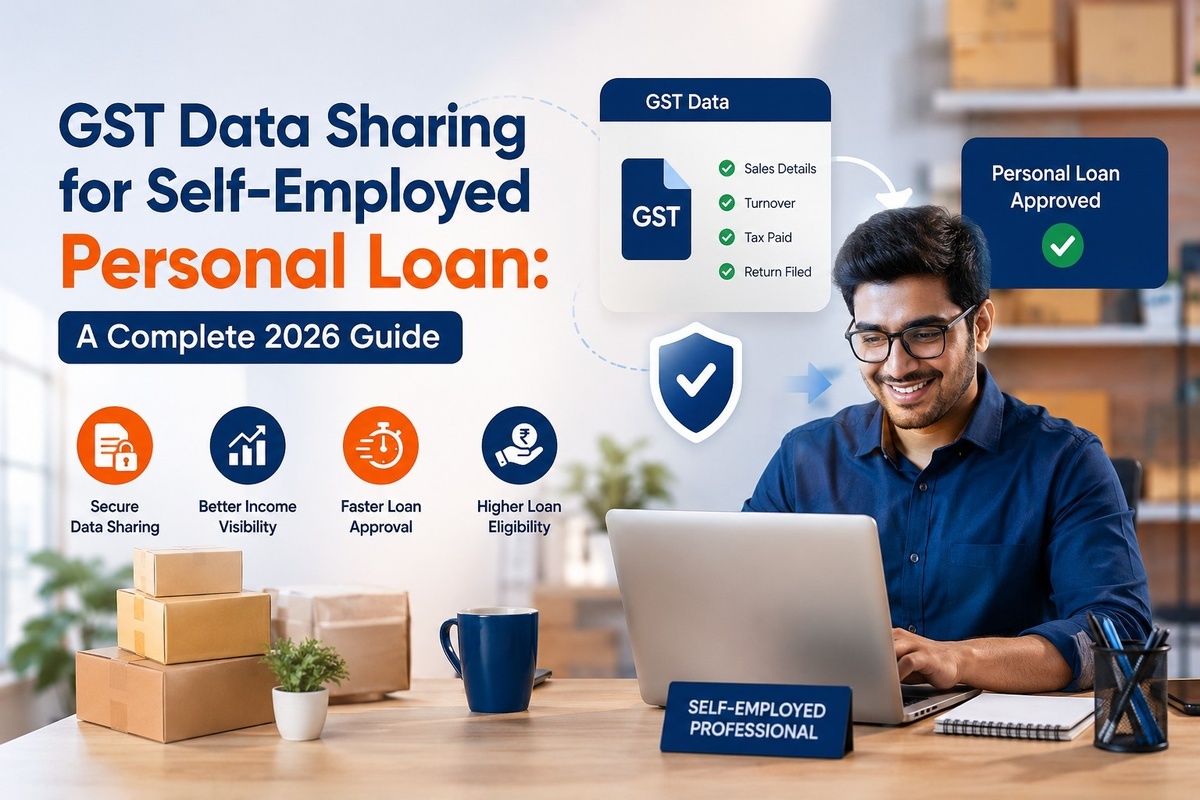
GST Data Sharing for Self-Employed Personal Loan: A Complete 2026 Guide
❤️ Spread the Love
Getting a personal loan as a self-employed professional can involve more verification than it does for a salaried applicant. Salaried employees generally have fixed monthly income and standard salary documents, while freelancers, consultants, traders, shop owners and entrepreneurs may earn different amounts every month.
Under the Account Aggregator (AA) framework, financial information can be shared electronically between participating institutions only after the customer gives explicit consent. RBI's framework recognises GST returns—Form GSTR-1 and Form GSTR-3B—as financial information, and the Goods and Services Tax Network (GSTN) is recognised as a Financial Information Provider.
Why Self-Employed Borrowers May Face More Verification
Self-employed income is often uneven. A consultant may receive payment only after completing a project, while a retailer may earn more during peak seasons and less during quieter months.
This can make cash-flow assessment important when a lender evaluates a self-employed applicant.
Sahamati explains that combining bank-statement data with tax data can support cash-flow-based financing. Bank-statement information can help lenders understand cash flows, while GST information can provide an additional view of tax-related business activity.
Together, these sources can give lenders a broader understanding of an enterprise's financial capability.
For a self-employed borrower, this can be useful because business performance may not always be reflected through a fixed monthly income pattern.
What Is the Account Aggregator Framework?
The Account Aggregator framework is a consent-based financial data-sharing system introduced under RBI regulations.
According to the Department of Financial Services, Account Aggregators are NBFCs that retrieve or collect a customer's financial information and facilitate its transfer between participating financial institutions.
The framework operates on one important principle: your financial information cannot be retrieved, shared, or transferred without your explicit consent. Registering with an Account Aggregator is also voluntary for consumers.
RBI rules further state that financial information accessed from a Financial Information Provider should not reside with the Account Aggregator. Account Aggregators are also prohibited from requesting or storing customer authentication credentials such as passwords, PINs or private keys.
This makes the AA framework different from simply uploading financial documents to different platforms. It establishes a regulated mechanism through which authorised data can move between participating entities, subject to the customer's consent.
How GST Data Fits Into the AA Ecosystem
RBI's Account Aggregator Master Directions specifically include Form GSTR-1 and Form GSTR-3B within the definition of financial information. GSTN is also included in RBI's definition of a Financial Information Provider.
Sahamati states that GSTN has gone live on the AA network as a Financial Information Provider. The integration is intended to make GST information available for financial use cases such as cash-flow-based underwriting.
According to Sahamati, GST information available through the framework can include:
Completed GSTR-1 information relating to outward supplies
GSTR-3B summary return information
Return-filing information
Basic business profile details
Sahamati also states that completed returns can be available for a period of up to 18 months, depending on the period for which data is requested and the taxpayer's filing frequency.
So, how can this actually fit into a self-employed borrower's loan journey?
Step 1: Check Whether GST Data Is Relevant to Your Application
Start by checking whether you are registered under GST and whether the lender uses GST information through the Account Aggregator framework for the loan product you are applying for.
If you are GST-registered, review your GST profile and previously filed returns before beginning the application.
The official GST portal allows registered taxpayers to access and manage returns, including GSTR-1 and GSTR-3B. The portal also provides facilities to view previously filed returns.
If GST registration does not apply to your profession or business, GST-based verification may not form part of your loan journey.
The lender would then rely on the financial information and documentation required under its own lending process.
Step 2: Review Your GST Filing Record
Before applying, check the GST returns you have already filed.
Make sure the applicable returns have been submitted and review your records for obvious errors, missing information or details that may need correction.
GST records can provide useful information about the activities reported by your business. Sahamati's description of GST information available through AA includes outward-supply information from GSTR-1, GSTR-3B summary information, and return-filing data.
The official GST portal also allows taxpayers to access their return-filing history and view filed returns.
Regular GST filing does not automatically establish that you can repay a loan, but keeping your records accurate gives lenders cleaner information to work with if GST data forms part of their assessment.
Step 3: Check Whether the Lender Supports AA-Based GST Sharing
Not every personal loan application automatically uses Account Aggregator-based GST data.
Therefore, check whether your lender supports an AA-enabled GST data-sharing journey before assuming GST information will be used in your application.
The Department of Financial Services lists GSTN among the entities that can participate in the AA ecosystem as a Financial Information Provider (FIP).
It defines a Financial Information User (FIU) as an entity registered with and regulated by a financial-sector regulator.
This means the relevant lender and data provider need to participate in the framework for the data-sharing journey to work.
If the lender does not use GST information through AA for the relevant loan product, you may need to follow its usual income and document-verification process instead.
Step 4: Enter Your Financial Information Accurately
When completing the loan application, make sure the personal, income and business details you provide are accurate.
Do not assume that numbers appearing in GST records, bank statements, business profits and taxable income should always be identical. These records capture different aspects of your finances.
What matters is that your financial information is accurate and that significant differences can be reasonably explained when required.
For example, business turnover is not necessarily the same as the income ultimately available to the business owner. Similarly, bank-account transactions can contain receipts and payments that need to be viewed in context.
A complete financial profile therefore matters more than relying on one isolated number.
Step 5: Review the AA Consent Request
If the lender uses an Account Aggregator during the application, you will receive a consent request before your financial information is shared.
This is an important part of the process.
RBI requires an AA consent artefact to contain details including:
The nature of the financial information being requested
The purpose for collecting that information
The identity of the recipient
Consent creation and expiry information
Before approving the request, check what information is being requested, why it is required, and who will receive it.
Consent should not be treated as another checkbox that needs to be accepted quickly to complete the application.
Step 6: Authorise the Data Sharing
Once valid consent is provided, the Financial Information Provider verifies the consent before securely transmitting the authorised financial information.
RBI requires the provider to verify the validity of the consent, the specified dates and usage, and the credentials of the Account Aggregator. After verification, the information is securely transmitted according to the terms of the consent.
The Account Aggregator can then securely transfer the information to the intended Financial Information User.
Importantly, RBI also requires Account Aggregators to provide customers with the ability to revoke consent, including consent relating to only part of the financial information made accessible.
Step 7: Let the Lender Assess GST Data Alongside Other Information
GST data is most useful when it is viewed as one component of your wider financial profile.
Sahamati explains that combining bank-statement information with GST data can help lenders understand both an enterprise's cash flow and its tax-related business information.
This can strengthen cash-flow-based assessment, especially for businesses that may not fit traditional collateral or credit-history models.
For self-employed applicants, this is relevant because income may not arrive in equal instalments every month.
The lender can use the authorised information available to better understand business activity and filing patterns. However, GST filings should not be treated as proof that every lending requirement has automatically been satisfied.
Step 8: Keep Your Other Financial Records Ready
Even when GST information is shared digitally, you should keep your other financial records properly organised.
The Account Aggregator framework enables data sharing; it does not replace the lender's underwriting process or determine whether your application should be approved. Therefore, make sure that the banking, tax, business and income information you provide presents a clear picture of your financial position.
If the lender requires additional verification, having organised records can help you respond without unnecessary delays.
How GST Data Sharing Can Help Self-Employed Borrowers
One of the main benefits of AA-based GST sharing is that authorised financial information can move digitally between participating institutions with customer consent.
Sahamati describes Account Aggregators as using technology to enable the simple and secure exchange of financial data.
For lenders, GST data can add standardised tax information to the credit-assessment process.
Sahamati specifically highlights the role of GST information in supporting cash-flow-based underwriting and enabling lenders to make more informed lending decisions.
For self-employed borrowers, the practical benefit can be greater financial visibility.
Instead of depending only on manually submitted information, an AA-enabled lender can receive authorised financial data directly through the ecosystem.
This can help create a more complete view of the business when GST information is considered together with other relevant financial data.
What GST Data Cannot Do
GST data can strengthen financial verification, but it should not be seen as a shortcut to personal loan approval.
GST returns primarily provide tax-related business information. They do not independently establish every aspect of a borrower's overall financial position or repayment capacity.
Similarly, being registered under GST or filing GST returns regularly does not mean a loan must be approved.
The lender remains responsible for its own credit assessment and eligibility decision.
GST data should therefore be treated as supporting financial evidence, rather than a guarantee of approval.
Tips to Strengthen Your Loan Application
Before submitting your application:
Keep your GST registration details updated.
File applicable GST returns on time and review filed information for accuracy.
Enter your income and business details correctly in the loan application.
Keep banking, tax and business records organised.
Check whether the lender supports an Account Aggregator-based GST journey.
Read the AA consent request carefully before approving it.
Authorise financial information only for the stated purpose.
Respond promptly if the lender requires further clarification or documents.
These steps cannot guarantee loan approval, but they can help make your financial profile clearer and reduce avoidable issues during verification.
Conclusion
For self-employed professionals, demonstrating financial stability can be an important part of a personal loan application. Monthly income may fluctuate even when the underlying business is performing well, which makes reliable financial information valuable during credit assessment.
The Account Aggregator framework provides a regulated and consent-based way to share financial information digitally. RBI recognises GSTR-1 and GSTR-3B as financial information and GSTN as a Financial Information Provider.
The Department of Financial Services also confirms that customer participation is voluntary and financial information cannot be shared without explicit consent.
When a lender supports GST data through the AA ecosystem, this information can provide an additional view of business activity and complement other financial information used during assessment.
Sahamati also highlights the potential of GST information to support cash-flow-based underwriting.
The key is to treat GST data as supporting evidence rather than a guarantee of approval. Review your GST filings, keep your records accurate, understand the consent request, and check whether your lender supports the relevant AA journey.
For a self-employed borrower, a clear, organised and verifiable financial trail can make the application process more transparent and easier for the lender to assess.
Build a stronger financial profile with Credit Assist
Managing loans, eligibility, and documentation becomes much easier when you have the right financial tools in place. Credit Assist helps self-employed individuals and professionals understand their credit options better and apply with confidence.
Explore plans, pricing, and features designed to simplify your loan journey here:
👉 https://creditassist.in/#pricing
Frequently Asked Questions
Can GST data be used for a personal loan?
Is GST data sharing safe?
Does GST data guarantee loan approval?
How much GST history can lenders access?
About the Author
Himanshu Mishra
@himanshu
View all posts →