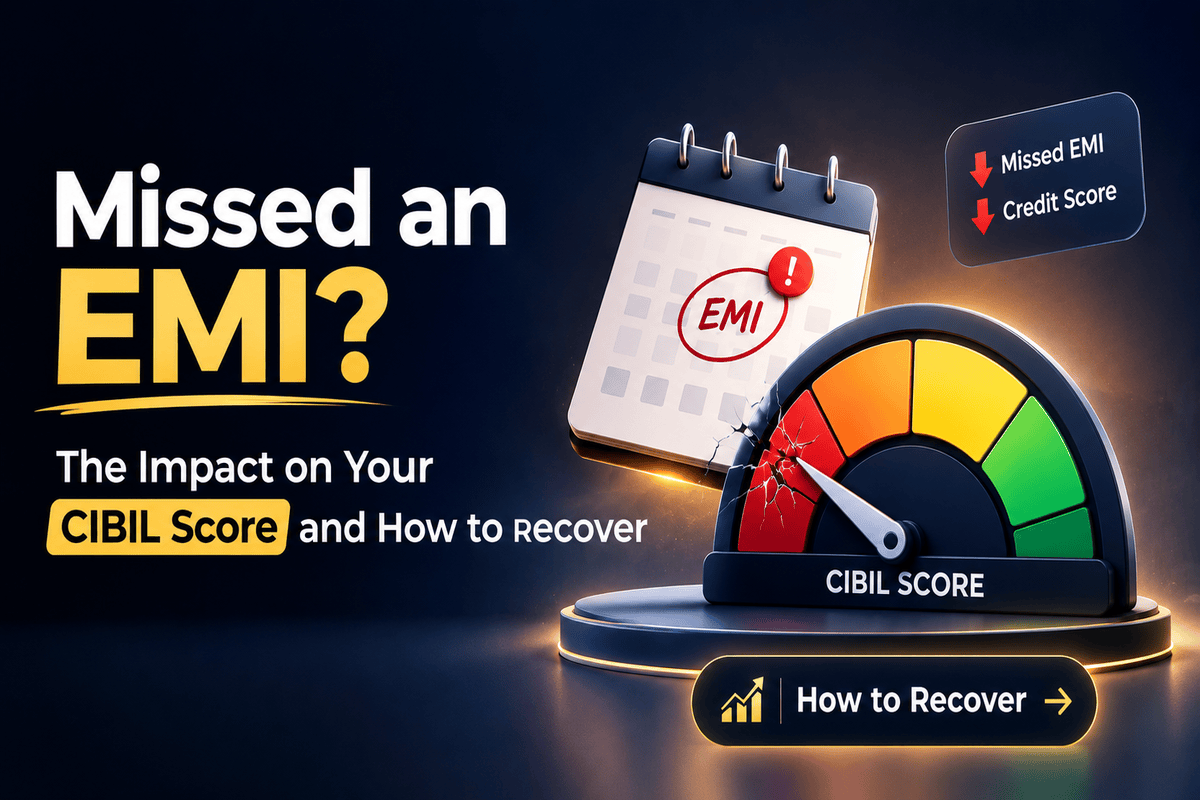
Missed an EMI? The Impact on Your Credit Score and How to Recover
❤️ Spread the Love
Missing an EMI is far more common than people admit, and the panic that follows is often worse than the damage itself. Still, the missed EMI impact on your CIBIL score is real, and knowing exactly what happens next is the difference between a quick recovery and a lingering dent.
A single missed EMI left unpaid for more than 30 days is usually reported to the bureaus and can cut your CIBIL score by around 50 to 100 points, depending on your profile. The mark can stay on your report for up to seven years. Pay it as soon as you can, keep every future payment on time, and most people recover within 6 to 12 months.
What happens after you miss an EMI, day by day?
The damage does not all land at once. It builds in stages, and understanding the timeline helps you act before a small slip becomes a lasting mark.
In the first few days after the due date, your lender typically charges a late fee and an EMI bounce charge, but the delay may not yet reach the bureaus. This is not a guaranteed safe window, though. A short delay can still attract charges and, with some lenders, an internal overdue record, so even an early delay is never truly cost-free.
Once you cross 30 days past due, the account is usually classified in the lender's overdue category and the delay is reported to the credit bureaus as a Days Past Due (DPD) entry. This is the point at which a missed EMI genuinely dents your CIBIL score. If the dues stay unpaid for longer, the account moves through steeper overdue stages, and beyond 90 days it can be classified as a non-performing asset, which is far harder to undo. The lesson is simple: the sooner you clear the amount, the smaller the mark.
How many points does a missed EMI cost you?
There is no single fixed number, and any article quoting an exact figure is estimating. In practice, the missed EMI impact on your CIBIL score commonly lands between 50 and 100 points, and occasionally more, depending on how high your score was and how late the payment is.
Counter-intuitively, a strong score often falls the hardest. A borrower at 800 with a spotless record has more to lose from a single slip than someone already at 650. The reason sits in how scores are built: payment history is widely estimated to be the single biggest factor, at roughly 35% of your score, though CIBIL does not publish its exact formula. So when people ask, does one missed EMI affect credit score noticeably, the honest answer is yes, because it strikes at the part that matters most.
How long does a missed EMI stay on your report?
The entry itself is stubborn. A reported late payment can remain on your CIBIL report for up to seven years, and there is no legitimate way to erase an accurate record early.
The good news is that its weight fades long before it disappears. A one-off slip from two years ago, sitting under a steady run of on-time payments since, barely registers with a lender compared with a fresh one. With the RBI now requiring lenders to update the bureaus at least every 15 days, both the damage and the recovery show up faster than they once did, which rewards prompt action.
Step by step: how to recover your score
The route back is straightforward, and it starts the moment you notice the miss. Here is how to recover CIBIL after a missed EMI:
Pay the overdue amount immediately, including any late fee, and confirm the payment is recorded against the account.
Set up auto-debit for every EMI and card bill, so a slip can never happen by accident again.
Keep a one-month buffer in your account, so a tight month does not become a missed one.
Keep your credit utilisation low, ideally under 30%, since this lifts your score while the late mark fades.
Check your report, and if the EMI was recorded wrongly, raise a dispute with proof, since bureaus must have the lender verify and correct genuine errors.
None of these are complicated. Consistency is what does the real work of missed loan payment recovery.
Your month-by-month recovery plan
Recovery is gradual, and knowing the typical shape of it keeps you patient rather than anxious. The timings below are indicative and vary with your profile.
Timeframe | What is happening | What to do |
Months 1-3 | The score stabilises after the initial drop; no quick jump yet | Clear all dues, switch on auto-debit, pay everything on time |
Months 3-6 | Small gains begin, often around 10 to 20 points | Keep utilisation low, avoid new loan applications |
Months 6-12 | Meaningful recovery as fresh on-time history outweighs the slip | Stay consistent; check your report for accuracy |
By the end of a clean 6-to-12-month stretch, most borrowers are close to where they started, and the single missed EMI becomes a footnote rather than a barrier.
What to do if you know you will miss the next one
Prevention beats recovery, and if you can already see a tight month coming, act early. Speak to your lender before the due date, not after. Lenders would far rather adjust than chase, and depending on your situation they may offer a short deferment, a revised due date, or a restructuring of the loan.
The worst move is to go silent and simply let the payment lapse. A proactive conversation can sometimes keep a late payment off your CIBIL report entirely, whereas silence guarantees the mark. If genuine hardship is the cause, ask specifically about the relief options available on your loan type.
How Credit Assist helps
A missed EMI is often a slip of memory, not money, and that is exactly what support is for. Credit Assist keeps an eye on your score as it recovers, flags upcoming risks before they become misses, and helps you dispute any late mark that was recorded in error. If an old missed payment or a wrong entry is still weighing on your report, we help you clear the path so your fresh, on-time history counts for as much as it should.
Frequently Asked Questions
Does one missed EMI affect my CIBIL score?
How many points does a missed EMI reduce my score?
How long does a missed EMI stay on my CIBIL report?
How long does it take to recover after a missed EMI?
Is a payment a few days late reported to CIBIL?
About the Author
Khushi Mishra
@khushi.mishra@paymeindia.in
View all posts →