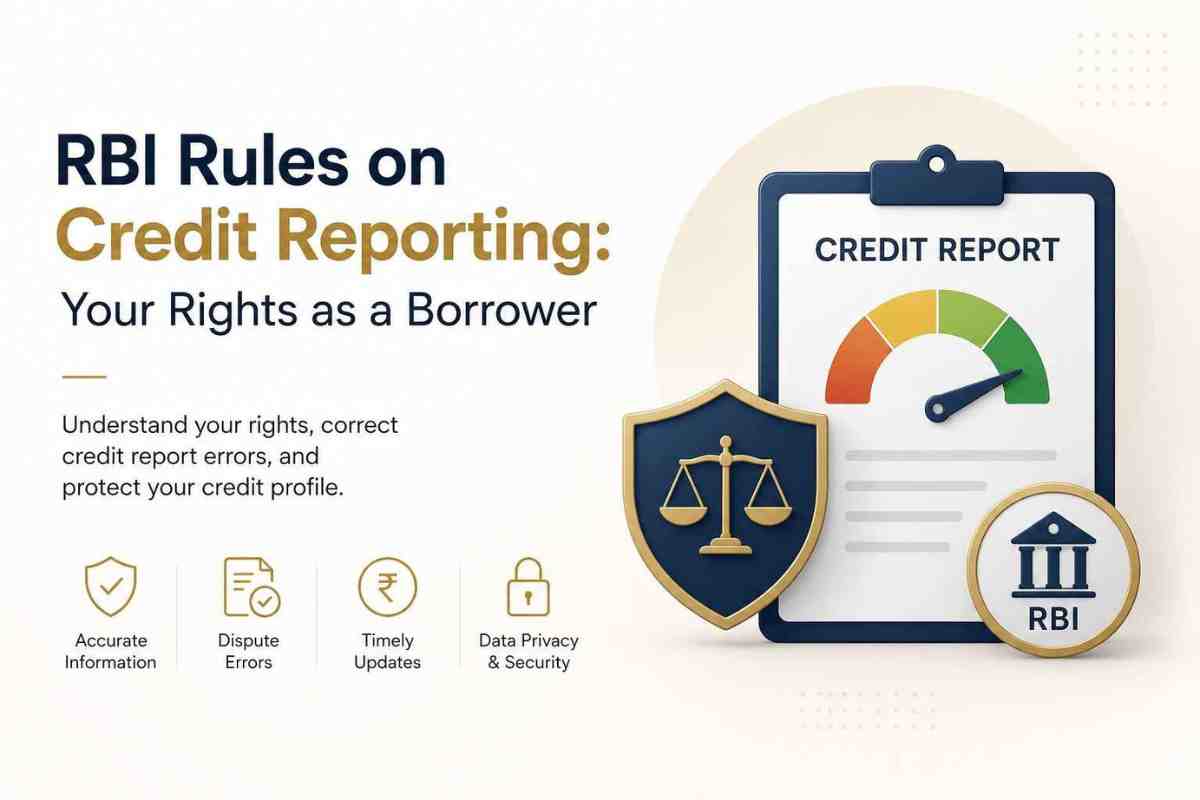
RBI Rules on Credit Reporting: Your Rights as a Borrower
❤️ Spread the Love
Most borrowers only check their credit report after a loan or credit card application is rejected. By then, correcting an error can delay approvals and affect borrowing costs. Since banks and NBFCs rely on credit bureau data to assess creditworthiness, even a small inaccuracy can have real financial consequences. That's why the Reserve Bank of India (RBI) has laid down clear rules governing credit reporting, dispute resolution, and borrower rights. This guide explains those rules, what they mean for you, and how to get errors in your CRIF credit report corrected.
What is a CRIF Credit Report?
A CRIF credit report is a detailed record of your borrowing history, compiled by CRIF High Mark, one of the four credit bureaus licensed by the RBI in India. The other three are TransUnion CIBIL, Experian, and Equifax. Every time you take a loan, use a credit card, or apply for new credit, that activity feeds into your file, and lenders pull it to judge whether you're a safe bet.
Open up your report and you'll find:
Your loan history, including home loans, personal loans, auto loans, and any EMIs you're currently paying
Credit cards, with limits, balances, and how you've been repaying them
Payment history, showing on-time payments and any missed or late ones
Outstanding dues across all your active accounts
Enquiries, meaning every time a lender checked your report for a fresh application
Defaults, settlements, or write-offs, if any exist
Sitting on top of all this is your CRIF High Mark credit score, a three-digit number between 300 and 900. Anything above 700 is generally treated as good, and crossing 750 usually unlocks the better interest rates. CRIF is especially strong in data from microfinance institutions, rural lenders, and digital NBFCs, so if you've borrowed from a fintech app or a smaller lender, that history often shows up on your CRIF credit report faster than anywhere else.
What does RBI say About Credit Reporting?
Credit reporting in India is governed by the Credit Information Companies (Regulation) Act, 2005 (CICRA) and the RBI (Credit Information Reporting) Directions, 2025. These regulations establish how banks, NBFCs, and licensed credit bureaus collect, report, update, and share borrowers' credit information.
The RBI requires lenders to report accurate, complete, and timely credit data so that your credit report reflects your actual repayment history. If you identify incorrect information, you have the right to raise a dispute, and lenders and credit bureaus must resolve it within the timelines prescribed by the RBI. The regulations also provide for compensation if these timelines are not met.
The framework applies to all regulated entities, including banks, NBFCs, small finance banks, cooperative banks, and credit information companies. It also sets standards for data security, borrower consent, information sharing, and record retention to ensure that your credit information is handled responsibly.
In short, the RBI's credit reporting framework is designed to make the credit ecosystem accurate, transparent, and accountable, while protecting borrowers' rights and ensuring fair access to credit.
Your Rights as a Borrower Under RBI Credit Reporting Rules
The RBI (Credit Information Reporting) Directions, 2025 protect borrowers by ensuring that credit information is accurate, transparent, and updated on time. Here are the key rights every borrower should know.
1. Right to Accurate Credit Information
You have the right to an accurate and complete credit report. Banks, NBFCs, and credit bureaus must report and maintain correct credit information. If your report contains incorrect loan details, repayment history, or account status, you can request a correction under the RBI's dispute resolution framework.
2. Right to Dispute Credit Report Errors
If you identify incorrect information in your CRIF credit report, you can raise a dispute with the credit bureau or the reporting lender. They are required to investigate the issue and resolve it within the timelines prescribed by the RBI, ensuring errors do not unfairly impact your credit profile.
3. Right to One Free Credit Report Every Year
Every licensed credit bureau, including CRIF High Mark, must provide you with one free credit report and credit score each calendar year. This allows you to review your credit history, identify inaccuracies, and monitor your credit health without incurring any charges.
4. Right to Timely Credit Report Updates
The RBI requires lenders to update borrowers' credit information on a weekly basis. Regular reporting ensures that repayments, loan closures, and other account changes are reflected promptly, helping maintain an accurate and up-to-date credit profile.
5. Right to Fair and Transparent Resolution
If your credit report correction request is rejected, the lender or credit bureau must communicate the reason. The RBI's framework promotes transparency and accountability, enabling borrowers to understand the decision and take the necessary steps to resolve the issue.
Common Errors Found in Credit Reports:
Errors are more common than most people assume, and a single one can drag your score down. These are the ones that turn up again and again on a credit report:
Wrong PAN mapping, where someone else's account gets tagged to your PAN
Duplicate loans, where the same loan appears twice and inflates your outstanding debt
Incorrect overdue amounts that you've already paid off
A closed account that still shows as active or open
Identity mismatches, where personal details or addresses are jumbled with another person's
Payments not updated, so an on-time EMI shows as missed
If you spot any of these, treat them as fixable. None of them are permanent, and every one of them is grounds to dispute a credit report entry.
How to Raise a Dispute in Your CRIF Credit Report
Raising a dispute sounds intimidating, but the process is fairly mechanical once you know the steps. Here's how to challenge an error on your CRIF credit report:
Step 1. Download Your Report:
Pull your latest CRIF credit report from the CRIF High Mark website so you're working from the current version.
Step 2. Identify the Error:
Go through it line by line and pin down exactly what's wrong, whether it's a stray loan, a wrong balance, or a closed account marked active.
Step 3. Raise the Dispute:
File it through CRIF High Mark's dispute process, quoting the specific account and the exact problem. Vague complaints slow things down, so be precise.
Step 4. Upload Your Proof:
Attach whatever backs your claim, like a loan closure letter, a no-dues certificate, bank statements, or payment receipts.
Step 5. Let the Verification Run:
The bureau coordinates with the lender who reported the data to check your claim against their records.
Step 6. Get the Resolution:
Get the resolution. Once verified, the entry is corrected and your report is updated. Pull a fresh copy afterwards to confirm the fix landed.
If the bureau or lender doesn't resolve things properly, you can escalate to CRIF's grievance redressal officer, and beyond that, to the RBI Ombudsman. That escalation path is part of the RBI guidelines for credit bureaus, so it's a right, not a favour.
How long does credit report correction take?
As per the Reserve Bank of India (RBI) guidelines, a credit report correction must be resolved within 30 calendar days from the date you submit a complaint. This timeline is designed to ensure that disputes related to inaccurate credit information are addressed promptly and transparently.
The 30-day resolution period is divided into two stages. The lender or credit institution is required to verify your complaint and submit the corrected information to the credit bureau within 21 calendar days. Once the updated information is received, the credit bureau has the remaining 9 calendar days to process the changes and update your credit report.
If your complaint is not resolved within the prescribed 30-day period, you may be eligible for compensation of ₹100 for every calendar day of delay, as per the RBI's compensation framework. The compensation amount is credited to your registered bank account within five working days after the complaint is resolved.
Although many disputes involving factual errors are resolved before the deadline, cases that require verification from multiple lenders or involve complex records may take longer. However, the 30-day resolution timeline and the applicable compensation provisions remain in effect, ensuring accountability throughout the credit report correction process.
Tips to Maintain a Healthy CRIF Credit Report:
Maintaining a healthy CRIF credit report requires consistent financial discipline. Follow these practical credit management habits to strengthen your credit profile, improve your credit score, and enhance your long-term creditworthiness:
Pay every EMI and credit card bill on time: Payment history carries the most weight, and one missed payment can undo months of good behaviour.
Avoid firing off multiple loan applications at once: Each one triggers a hard enquiry, and a cluster of them makes you look desperate for credit.
Check your credit report regularly: Reviewing it a few times a year helps you catch errors and signs of identity theft early.
Keep your credit utilisation low: Using a large chunk of your available credit limit signals stress, so try to stay well under it.
Close unused loans and cards properly: Get a closure confirmation, and check that it reflects on your report.
Verify that updates actually show up: After a loan closure or a big payment, pull a fresh copy and confirm the change is there.
None of this is complicated. It's consistency that builds a strong CRIF credit report over time.
Difference Between CRIF, TransUnion CIBIL, Experian, and Equifax?
All four bureaus are licensed by the RBI, all follow the same RBI credit reporting rules, and all produce a score on the 300 to 900 scale. So why do your scores differ across them? Because each one has its own data network and its own scoring formula, which means a lender who reports to CIBIL might not report to CRIF, and small point-to-point variations are completely normal.
When people compare CIBIL vs CRIF, the real difference is coverage. CIBIL holds the oldest and deepest database among mainstream commercial banks. CRIF High Mark dominates in microfinance, rural lending, and digital NBFCs, so newer fintech borrowing often shows up there first. Experian and Equifax are global bureaus that operate widely across Indian banks and financial institutions.
Bureau | Data strength | Credit score | Used by |
CRIF High Mark | Microfinance, rural, NBFCs, fintech | 300-900 | Banks & NBFCs, widely |
TransUnion CIBIL | Mainstream commercial banks, oldest database | 300-900 | Most large lenders |
Experian | Broad coverage across banks | 300-900 | Many lenders |
Equifax | Financial institutions | 300-900 | Selected lenders |
Note: don't assume your CIBIL number is your only number. A lender might be pulling your CRIF credit report instead, so it's worth knowing what each one says.
Conclusion:
Your credit file has real power over your financial life, but the rules around it are firmly on your side. The RBI credit reporting rules give you the right to accurate data, the right to dispute errors, a free report every year, faster updates, and actual compensation when a bureau or lender stalls. The one thing they can't do is force you to look. So don't wait for a rejection to find out what's on your file. Pull your CRIF credit report, read it properly, and fix anything that's off before it costs you a loan. A little attention now is what keeps your credit profile working for you instead of against you.
Frequently Asked Questions
Is a CRIF credit report approved by RBI?
How can I check my CRIF credit report?
How often is my credit report updated?
Can I remove incorrect loan information?
Does checking my own credit report affect my score?
Can the RBI help if my report has mistakes?
What documents are needed to raise a dispute?
How long should lenders take to update repayment information?
About the Author
Khushi Mishra
@khushi.mishra@paymeindia.in
View all posts →