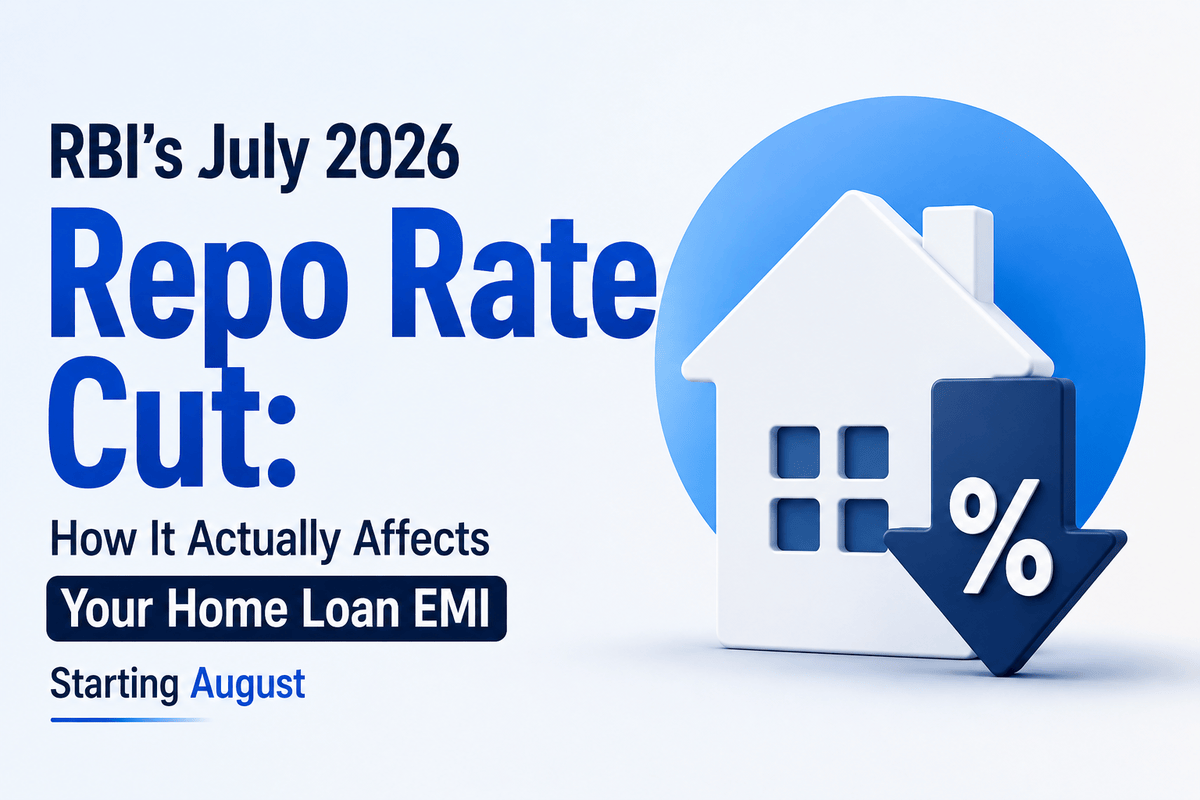
RBI's July 2026 Repo Rate Cut: How It Actually Affects Your Home Loan EMI Starting August
❤️ Spread the Love
Last week, a borrower reached out through our platform genuinely confused. His bank had announced a 25 basis point reduction in their external benchmark lending rate following the RBI's July 2026 policy announcement, yet his home loan EMI statement for August showed zero change. He assumed it was an error. It wasn't. This disconnect between what borrowers expect from an RBI rate cut and what they actually experience in their monthly outgo is perhaps the most misunderstood aspect of home loan mechanics in India. If you're among the millions of Indian homeowners waiting for relief in your August EMI, here's exactly what's happening — and what isn't.
What the July 2026 RBI Policy Actually Changed
The Reserve Bank of India reduced the repo rate by 25 basis points (0.25%) in its July 2026 monetary policy meeting, bringing it down to 6.00%. This marks the third consecutive cut this calendar year, with the cumulative reduction now standing at 75 basis points since February. The repo rate, simply put, is the rate at which commercial banks borrow from the RBI. When this rate falls, banks' cost of funds theoretically decreases, which should translate to lower interest rates on loans they offer to customers.
For home loan borrowers, this matters because most loans sanctioned after October 2019 are linked to external benchmarks — predominantly the repo rate. Under RBI guidelines, banks must adjust these repo-linked lending rates within three months of any policy change. However, "within three months" is doing a lot of heavy lifting in that sentence.
The Real EMI Impact: Numbers That Matter
Let's break down what a 25 basis point reduction actually means for your wallet. The impact varies significantly based on your outstanding principal and remaining tenure:
₹30 lakh outstanding, 15 years remaining: Monthly EMI drops from approximately ₹27,580 to ₹27,350 — a saving of ₹230 per month or ₹2,760 annually
₹50 lakh outstanding, 20 years remaining: Monthly EMI reduces from approximately ₹41,790 to ₹41,420 — a saving of ₹370 per month or ₹4,440 annually
₹75 lakh outstanding, 25 years remaining: Monthly EMI decreases from approximately ₹57,240 to ₹56,720 — a saving of ₹520 per month or ₹6,240 annually
These figures assume immediate and complete transmission of the rate cut. The reality, as we'll see, is often different.
The Tenure Reduction Alternative
Many banks default to reducing your loan tenure rather than your EMI amount when interest rates fall. This approach actually benefits borrowers more in terms of total interest saved over the loan's lifetime. Using the ₹50 lakh example above, keeping the same EMI while reducing tenure could shave off approximately 8-10 months from your loan and save you nearly ₹3.5 lakh in total interest payments. If you haven't explicitly requested EMI reduction, check whether your bank has adjusted tenure instead — it's not necessarily a disadvantage.
Why Your Bank Might Be Dragging Its Feet
Here's where the popular narrative gets oversimplified. Many borrowers believe and plenty of headlines suggest that banks simply pocket rate cuts and refuse to pass them on. The reality is more nuanced, though not entirely flattering to lenders either.
Banks face a structural challenge: while lending rates are now externally benchmarked, deposit rates are not. When the RBI cuts the repo rate, banks must reduce lending rates relatively quickly, but their deposit costs remain sticky. Depositors don't accept lower interest rates on their fixed deposits as readily as borrowers demand lower EMIs. This compresses bank margins and creates genuine reluctance to transmit cuts faster than required.
That said, the RBI's three-month transmission window is a maximum, not a target. Several banks have demonstrated they can pass on cuts within 30-45 days when competitive pressure demands it. If your bank consistently waits the full three months, they're prioritising margin protection over customer relationships. You should know this when you consider refinancing options.
SBI and other PSU banks: Typically transmit within 30-45 days; August EMIs should reflect the cut
Large private banks (HDFC Bank, ICICI Bank, Axis Bank): Variable approach; some wait 60-90 days
Smaller private and foreign banks: Often use the full three-month window; September or October reflection more likely
What You Should Actually Do This Month
First, log into your loan account or contact your bank to confirm whether your home loan is repo-linked (RLLR or EBLR) or still on the older MCLR system. MCLR loans are benchmarked internally and typically reset only annually or semi-annually on your loan anniversary date. If you're on MCLR and haven't switched to an external benchmark, you might be missing out on significant savings though do calculate the switching cost before deciding.
Second, explicitly request EMI reduction if that's what you prefer over tenure reduction. Most banks will accommodate this, but you need to ask. Don't assume they'll automatically choose what's better for your monthly cash flow.
Third, compare your current effective interest rate against prevailing market rates. If your bank has been slow to transmit cuts and your rate is significantly higher than what new borrowers are getting, balance transfer to a more responsive lender might save you more than waiting for transmission.
Document Everything
Keep records of your bank's stated interest rate on your last three EMI statements. If there's a discrepancy between the announced benchmark rate and what you're being charged beyond the spread mentioned in your sanction letter, you have grounds to escalate first through the bank's grievance mechanism, then to the Banking Ombudsman if needed.
The Bigger Picture on Home Loan Interest Rates
RBI policy has been accommodative throughout 2026, and market expectations suggest we may see another 25-50 basis points of cuts before year-end if inflation remains contained. For prospective buyers, this creates an interesting decision point: waiting for further cuts means potentially lower EMIs but also risks property price appreciation that could offset those gains. For existing borrowers, the focus should be on ensuring you're actually receiving the benefits of each cut as it happens.
The Indian home loan market has become meaningfully more borrower-friendly since the shift to external benchmarking. Transmission that used to take 12-18 months during the MCLR era now happens in 1-3 months. That's genuine progress, even if individual bank behaviour remains frustrating.
Your August EMI statement will tell you whether your bank treats you as a customer worth retaining or a borrower too inertia-bound to switch. If it's the latter, remember that home loan balance transfers have never been easier, and the math often favours moving. Don't let institutional convenience determine what you pay.
Frequently Asked Questions
How does the RBI repo rate cut affect home loan EMIs?
Will my home loan EMI reduce immediately after the RBI repo rate cut?
Who benefits the most from the RBI's July 2026 repo rate cut?
Should I reduce my EMI or shorten my loan tenure after the repo rate cut?
How can I check if my home loan interest rate has been reduced?
About the Author
Khushi Mishra
@khushi.mishra@paymeindia.in
View all posts →