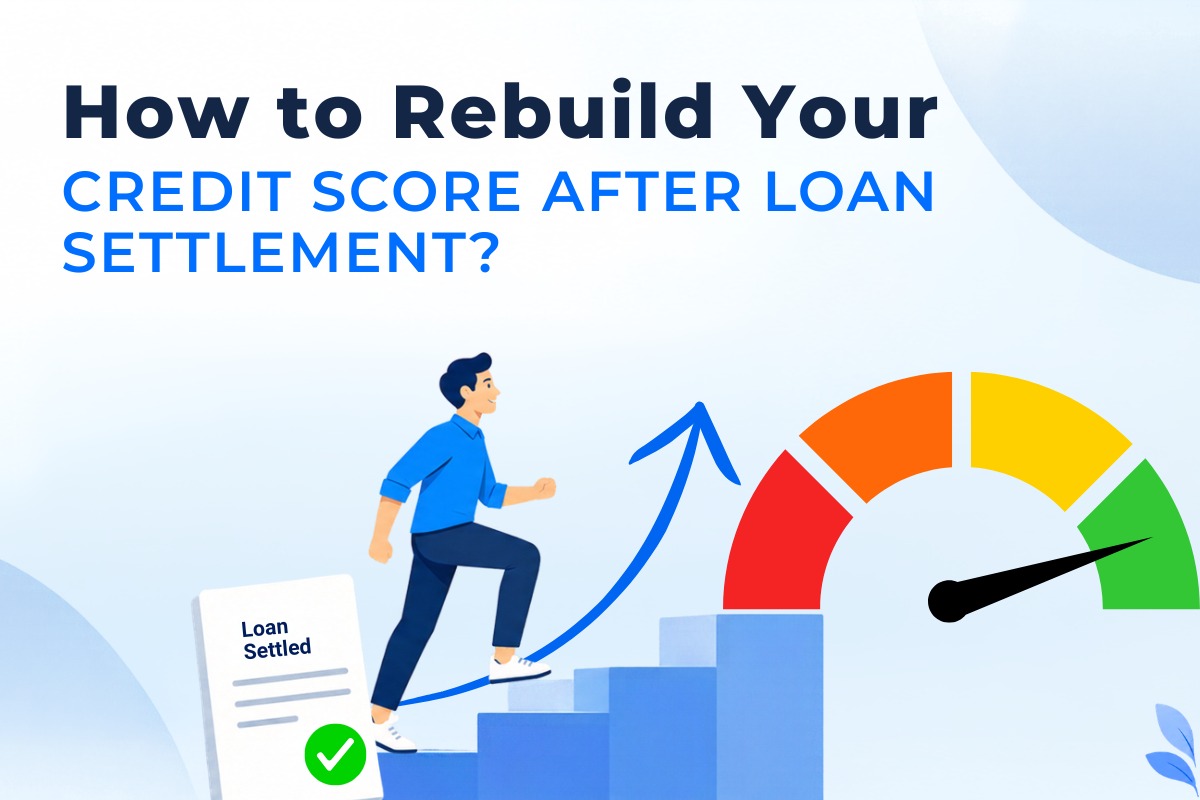
How to Rebuild Your CIBIL Score After Loan Settlement?
❤️ Spread the Love
A loan settlement can affect your credit profile because it means the lender accepted less than the full amount originally due. If your account is reported as “Settled”, rebuilding your credit requires more than simply waiting for your score to rise. You need to check the report, correct inaccurate information, address the outstanding amount where possible and build a fresh record of timely repayments.
The first priority is to check whether the settled account can be converted to “Closed” by paying the remaining amount, obtaining a No Objection Certificate (NOC) and getting the lender to update the credit report. After that, consistent repayments, controlled credit utilisation and limited new applications can help rebuild your credit profile over time.
What Happens to Your CIBIL Score After a Loan Settlement?
A loan is generally reported as “Settled” when the lender accepts an amount lower than the full amount outstanding. A loan that has been completely repaid, on the other hand, can be reported as “Closed”.
These two statuses are not interchangeable.
TransUnion CIBIL itself illustrates the difference through a case where a borrower had settled a loan for less than the complete amount payable. The lender reported it as “Settled”, and the borrower later had to pay the remaining amount, obtain an NOC and raise a dispute before the status was changed to “Closed”.
This distinction matters when you are trying to rebuild credit after settlement. A settled account tells a prospective lender that the original obligation was not fully repaid under the original terms.
That does not mean your credit profile can never recover. It means the recovery process needs to focus on both correcting the account status where possible and establishing better repayment behaviour going forward.
Can You Remove a Settled Status From Your CIBIL Report?
You cannot simply ask CIBIL to delete a correctly reported settlement.
If you have subsequently paid the remaining amount that was waived as part of the settlement, you can approach the lender, obtain an NOC or other appropriate confirmation and request that the lender update the account information. You can then raise a dispute with CIBIL if the report has not been updated.
CIBIL states that it cannot independently modify information supplied by a credit institution without confirmation from that institution.
This is an important distinction in credit report correction:
If the settlement information is accurate, it cannot simply be erased because you do not want it on the report.
If you have subsequently cleared the remaining amount, ask the lender to update the account status.
If information is inaccurate, you can raise a CIBIL dispute.
Keep your payment receipts, NOC and correspondence with the lender as supporting records.
If you are specifically looking for how to remove settled status from your CIBIL report, the practical route is therefore through the lender and supporting documentation—not through a third party promising to “delete” the entry.
How to Improve CIBIL Score After Loan Settlement
Once the account has been addressed, the next stage is rebuilding your credit profile. There is no instant credit repair method. Your focus should be on creating a consistent record that demonstrates responsible credit behaviour.
1. Check Your Complete Credit Report
Start by reviewing the entire report rather than looking only at your three-digit score.
Check the settled account carefully. Look at the account status, outstanding balance, payment history, date reported and other account details.
Then check the rest of the report for:
Incorrect account balances
Duplicate accounts
Incorrect payment information
Accounts that do not belong to you
Unrecognised credit enquiries
Personal information that is inaccurate
This step is important because credit report errors can continue to affect your profile even after you have changed your financial behaviour.
CIBIL says credit institutions generally submit information within a defined reporting period and advises consumers to raise a dispute when information remains inaccurate.
2. Try to Convert “Settled” to “Closed”
If you have the financial capacity to do so, contact the lender and ask what amount remains payable to fully regularise the account.
After making the required payment, obtain an NOC or other written confirmation from the lender. Then check whether the lender has updated the account with CIBIL.
TransUnion CIBIL's own example shows this process: the borrower paid the remaining outstanding amount, obtained an NOC and raised a dispute; the status was subsequently changed from “Settled” to “Closed” after confirmation from the lender. This is different from trying to dispute a genuine settlement simply because it is negatively affecting your credit profile.
If the account information is accurate, the bureau needs confirmation from the lender before making a change.
3. Pay Every EMI and Bill on Time
Once you begin rebuilding your credit, payment history becomes critical. Do not allow another missed EMI or credit card payment to become part of your recent repayment record. Set payment reminders, maintain sufficient funds before the due date and use auto-debit where it is suitable for you.
The aim is not to improve your CIBIL score through one payment. It is to establish a consistent pattern of on-time payments across your active credit accounts. This is also why rebuilding credit after settlement takes time. A lender evaluating a new application may consider your recent repayment behaviour along with your older credit history.
4. Keep Credit Utilisation Under Control
Credit utilisation refers to the amount of revolving credit you are using compared with your available limit. For example, if your total available credit-card limit is ₹1,00,000 and your outstanding balance is ₹30,000, your utilisation is 30%.
High utilisation can be a negative signal in a credit profile. TransUnion CIBIL identifies credit utilisation as one of the factors relevant to its score. A commonly used 30% guideline can be a practical benchmark, but it should not be treated as an official CIBIL cutoff or a guarantee of a particular score.
The more useful approach is to avoid consistently carrying very high balances relative to your available limits.
5. Build New Positive Credit History Carefully
After a settlement, you may feel tempted to take several new credit products simply to create fresh repayment history. That can backfire if you take on more debt than you can comfortably manage. If you have limited access to unsecured credit, a secured credit card backed by a fixed deposit may be one option to consider, subject to the issuer's eligibility criteria.
A Credit builder product can also be considered where appropriate. The important point is that the account should be reported to the relevant credit information company and managed responsibly. A Credit builder is not a shortcut around a previous settlement. Its purpose is to help create a record of responsible credit use over time.
Before taking any product, understand its fees, interest charges, repayment requirements and reporting practices.
6. Avoid Multiple Loan and Credit Card Applications
When rebuilding your credit profile, avoid applying for several products at the same time. Each lender may conduct a credit enquiry when assessing your application. Multiple recent enquiries can become part of your credit profile and may affect how your credit-seeking behaviour is viewed.
Instead, apply only when you have a genuine requirement and have checked whether you are likely to meet the lender's eligibility criteria. This is particularly relevant after loan settlement, when you are trying to establish a more stable recent credit record.
How Long Does It Take to Rebuild Credit After Settlement?
There is no official CIBIL timeline that guarantees recovery within a particular number of months.
However, the actual period can vary significantly. Someone who has corrected a reporting error and then maintains clean repayment behaviour is in a different situation from someone with multiple missed payments, high utilisation and several recent credit enquiries.
Think about recovery in stages rather than expecting a single score jump.
Period | What to focus on | Credit recovery objective |
Month 1 | Check your report and settlement status | Identify errors and understand the account position |
Month 2–3 | Address the lender, pay eligible outstanding balance and obtain NOC | Work towards accurate account reporting |
Month 3–6 | Pay every bill on time and control utilisation | Establish a clean recent payment record |
Month 6–9 | Maintain existing accounts responsibly | Build consistency without unnecessary applications |
Month 9–12 | Continue low utilisation and timely payments | Strengthen recent credit behaviour |
12–24 months | Maintain the same discipline | Allow a longer positive repayment history to develop |
This is a planning framework, not a guaranteed CIBIL score recovery schedule.
Does Paying the Settled Amount in Full Help?
It can help address the settled account status if the lender accepts the remaining amount and subsequently reports the account as closed. However, paying the difference does not mean every negative effect on your credit profile disappears immediately. The account history and other information in your credit report still form part of your overall credit profile.
The distinction is important:
Paying the remaining amount → lender confirmation → account status update → continued responsible credit behaviour.
It is the combination of these steps—not a single payment—that supports longer-term credit recovery. If you are dealing with this situation, keep every document related to the payment and settlement. It can make the credit report correction process easier if the lender's records and your report do not match.
Can You Get a Credit Card After a Loan Settlement?
Yes, it is possible, but approval depends on the lender and your overall credit profile. A secured credit card may be an option for some borrowers because it is generally backed by a fixed deposit. The issuer decides the eligibility criteria and terms.
If you already have access to a credit card, the priority should be responsible use rather than applying for several cards to rebuild your credit history. Use only an amount you can repay comfortably and pay the statement balance on time.
The same principle applies if you choose a Credit builder product: the product itself does not repair your credit profile; responsible repayment behaviour does.
Common Mistakes to Avoid After a Loan Settlement:
After settling a loan, rebuilding your credit requires consistent financial behaviour and accurate reporting. Avoiding these common mistakes can help you create a stronger repayment history and support gradual credit recovery.
1. Don’t Ignore Your Credit Report After Settlement:
Once your loan has been settled, check your credit report regularly to confirm that the account details, outstanding balance, payment history and settlement status have been reported accurately by the lender.
Check whether the settled account reflects the agreed settlement details.
Look for incorrect outstanding balances or payment entries.
Raise a dispute if you find inaccurate information.
Keep your settlement letter, receipts and other supporting documents safely.
2. Don’t Assume “Settled” Means “Closed”:
A settled loan and a closed loan do not represent the same repayment outcome. Understanding this distinction is important because the status reported by the lender can affect how future lenders view your credit history.
Settled: The lender accepted an amount lower than the total outstanding dues as part of the settlement.
Closed: The borrower has repaid the dues in full and the lender has closed the account.
If you later pay the remaining amount, ask the lender whether the account can be updated from “Settled” to “Closed”.
Obtain written confirmation of any status change.
3. Don’t Miss New EMI or Credit Card Payments:
After a loan settlement, your priority should be building a clean repayment record on every active credit account. One missed EMI or credit card payment can work against the repayment history you are trying to establish.
Set up reminders or automatic payment instructions where appropriate.
Pay EMIs and credit card bills by their due dates.
Avoid taking on repayments that you may struggle to manage.
Keep sufficient funds available before scheduled automatic payments.
4. Don’t Apply for Multiple Loans at Once:
Applying for several loans or credit cards within a short period can result in multiple hard enquiries on your credit report. After settlement, unnecessary applications can make your credit profile appear more dependent on new borrowing.
Apply only when you have a genuine credit requirement.
Compare eligibility requirements before submitting applications.
Avoid repeatedly applying after a rejection.
Focus on maintaining existing accounts before seeking additional credit.
5. Don’t Keep Your Credit Utilisation Consistently High:
If you use credit cards while rebuilding credit after settlement, keeping balances under control is important. High utilisation may indicate heavy dependence on available revolving credit and can affect your overall credit profile.
Monitor your outstanding credit card balance throughout the billing cycle.
Avoid regularly using most of your available credit limit.
Pay your bill on time rather than carrying unnecessary balances.
Do not increase spending simply because your available credit limit increases.
6. Don’t Pay Anyone Promising to Erase a Genuine Settlement:
A genuine loan settlement is part of your credit history and cannot simply be removed because someone promises to delete it. Be cautious of services offering guaranteed credit score increases or instant removal of accurate information.
Do not share sensitive credit or banking information unnecessarily.
Ask exactly what service is being offered before making a payment.
Dispute information only when you believe it is inaccurate.
Contact the lender or credit bureau through official channels for reporting-related issues.
How Credit Assist Can Help You Monitor Your Credit Recovery?
Credit recovery becomes easier to manage when you can see what is happening across your credit profile instead of checking your score occasionally and guessing what changed. Credit Assist helps you understand your credit health, monitor your credit report and identify areas that need attention.
After a settlement, that can mean keeping an eye on:
Account status
Payment history
Credit utilisation
Recent enquiries
Outstanding accounts
Changes in your credit profile
The goal is not to chase an arbitrary number every month. It is to understand whether your credit behaviour is moving in the right direction.
Conclusion:
A loan settlement does not have to define your entire credit history, but rebuilding after one requires consistency. Start with the report itself. Understand the settled status, correct inaccuracies, work with the lender if the account can be updated to closed, and then focus on the fundamentals: timely payments, controlled utilisation and responsible borrowing.
Credit Assist can help you stay on top of your credit health, understand what is changing and track your progress as you rebuild. Ready to take control of your credit profile? Explore Credit Assist and start your credit recovery journey today.
Frequently Asked Questions
How do I improve my CIBIL score after loan settlement?
Can I remove a settled status from my CIBIL report?
How long does it take to rebuild credit after settlement?
Can I get a credit card after a loan settlement?
What is the fastest way to rebuild credit after settlement?
About the Author
Khushi Mishra
@khushi.mishra@paymeindia.in
View all posts →