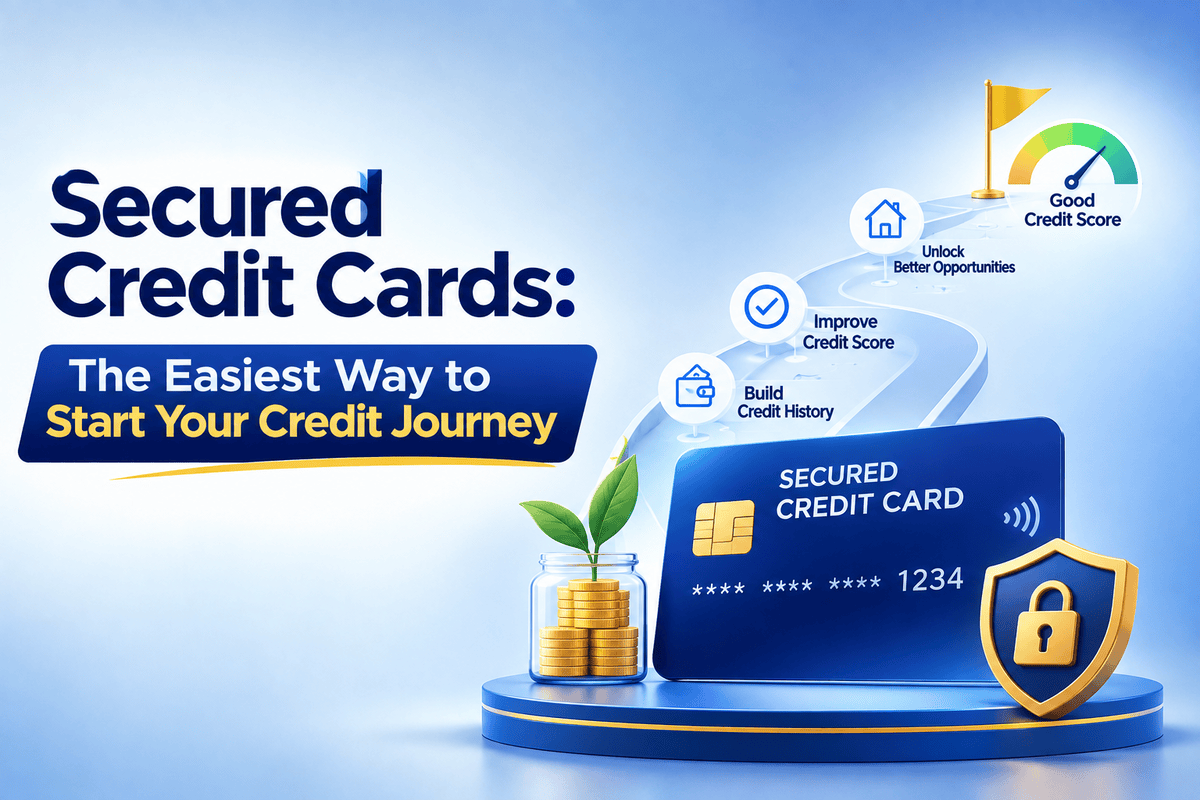
Secured Credit Cards: The Easiest Way to Start Your Credit Journey
❤️ Spread the Love
If you have no credit score yet, or a damaged one, you have probably hit the same frustrating wall: you need a credit history to get a card, but you need a card to build a credit history. A secured credit card is the simplest way out of that loop.
A secured credit card is issued against a fixed deposit, so you can get one with no credit history and no income check. The limit is usually 80 to 90 percent of your FD, and your FD keeps earning interest the whole time. Use it for small spends, pay the bill in full each month, and it steadily builds your credit score.
What a Secured Credit Card Is?
A secured credit card is a regular credit card, on the Visa, Mastercard, or RuPay network, that is backed by a fixed deposit you place with the bank. That deposit acts as collateral, which is why the bank does not need to check your credit score or income before issuing the card.
It works exactly like any other card at the shop or online. The only real difference sits in the background: your FD is held as security. If you were to stop paying, the bank could recover the dues from that deposit. As long as you pay your bills, the FD simply stays put, earning interest, while the card does its job. This is not a prepaid card, and it is not a loan against your FD. It is a proper credit card that reports to the bureaus like any other.
How Does a Secured Credit Card Build Your Credit Score?
This is the part that matters most, and it is where a credit card against an FD earns its place. A secured card reports your activity to credit and the other bureaus every month, exactly as an unsecured card does. That monthly report is what quietly builds your score.
Two things drive it. The first is payment history, which is the single biggest factor in a credit score. Every time you pay your bill in full and on time, a positive mark lands on your report, and a steady run of them is the strongest signal of reliability a lender can see. The second is credit utilisation, meaning how much of your limit you use. Keeping your spending to a small share of the limit, ideally under 30 percent, tells the bureau you handle credit sensibly. You can read more on both in our explainer on how a credit score is calculated and our guide to the 30% utilisation rule.
If you are starting from scratch, this is how a blank file, shown as NA or NH in bureau terms, turns into an actual score. Give it a few months of small purchases paid off on time, and lenders finally have a track record to judge you on. It is the same principle behind building your first credit score, just with a card in your hand.
The Limit and the FD: Your Money is Safe:
The limit is usually 80 to 90 percent of your FD (a few cards offer up to 100 percent). So, a ₹50,000 fixed deposit typically gives you a credit limit of around ₹40,000 to ₹45,000.
Your FD keeps earning interest the entire time it is pledged. You are not spending the deposit; it stays invested and continues to grow at the normal FD rate, while the card gives you separate credit to spend and repay.
The trade-off is that the deposit is locked under a lien until you close the card, so you cannot break it in the meantime. It also has to be a regular FD, not a tax-saver, NRI, or loan-linked one. Entry requirements are low: as of 2026, banks such as IDFC First, Kotak, Axis, and SBI offer these cards against deposits ranging from roughly ₹5,000 to ₹25,000, though exact terms vary by issuer and can change, so confirm the current details on the bank's own page before applying.
Who Should Get One?
A secured credit card suits anyone who cannot easily get a regular card yet. That includes first-time earners and students with no credit history, self-employed people and freelancers without salary slips, and anyone rebuilding after a low score or a past default. If a bank has already turned down your unsecured card application, a secured card is usually the sensible next step, because approval rests on your deposit rather than your record.
It is less useful if you already have a healthy score and can qualify for a good unsecured card outright. For everyone at the starting line, though, it is the most reliable entry point there is.
How to Use it Right?
Getting the card is easy. Using it in a way that actually builds your score comes down to a few simple habits:
Put small, regular spends on it, such as a phone recharge or a monthly subscription, so there is always something to repay.
Pay the bill in full by the due date, every month, rather than paying the minimum.
Keep your usage low, ideally under 30 percent of the limit, since low utilisation helps your score.
Avoid cash withdrawals, which carry charges and add no benefit here.
Stick to this one card while you build, instead of juggling several.
Done consistently, these habits do the quiet work of turning a secured card into a real, rising score.
How to Graduate with an Unsecured Card?
The goal is not to keep a secured card forever. It is a steppingstone. After roughly six to twelve months of on-time payments, your score should be healthy enough to move on.
At that point, one of two things usually happens. Your bank may offer to upgrade you to a regular unsecured card, or you can apply for a new card on the strength of the score you have built. Once you close the secured card, the bank releases your fixed deposit, and you get the principal back along with all the interest it earned along the way. In effect, your money was working for you the whole time you were building credit.
How Credit Assist Help?
The mechanism is simple, but staying on track still helps. Credit Assist lets you watch your score respond month by month as your secured card reports in, flags anything that looks off, and shows you when your profile is strong enough to graduate to an unsecured card. If your file has old errors or a past default holding you back, we help you clear those too, so your fresh, on-time history has the cleanest possible base to build on.
Conclusion:
A secured credit card is the easiest, safest way to start or rebuild your credit. Your deposit stays invested and earning, the approval is straightforward with no score needed, and every on-time payment moves you closer to a healthy credit score and a regular card. Used sensibly, it turns a frustrating chicken-and-egg problem into a clear path forward.
Frequently Asked Questions
What is a secured credit card?
Does a secured card build my credit score?
What credit limit do I get?
Does my FD still earn interest?
When can I move to a regular card?
About the Author
Khushi Mishra
@khushi.mishra@paymeindia.in
View all posts →