The 12-Month Credit Score Improvement Plan: A Month-by-Month Guide
❤️ Spread the Love
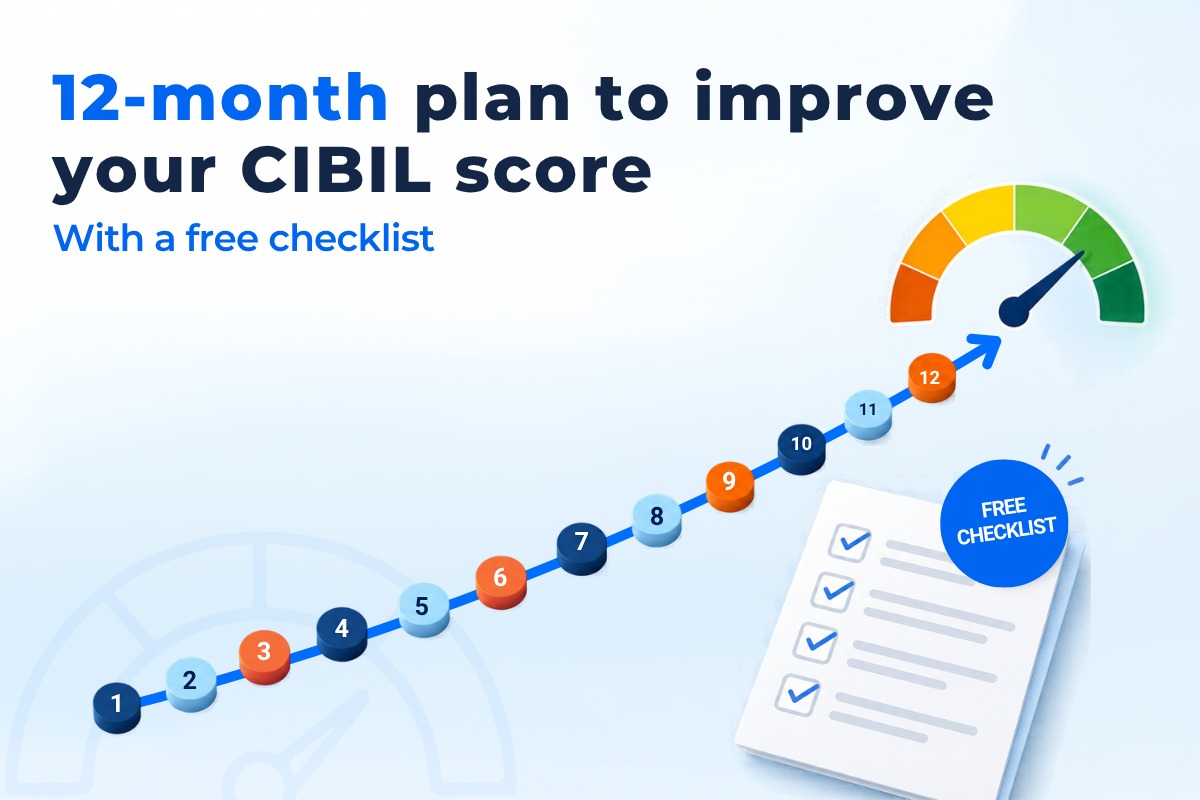
If your credit score is lower than you want it to be, the solution is usually not one big financial move. It is a series of smaller actions repeated consistently. This credit score improvement plan gives you a practical 12-month roadmap covering credit-report errors, utilisation, repayments, enquiries and credit history.
How Can You Improve Your Credit Score in 12 Months?
You can work towards a stronger credit profile within 12 months, but there is no fixed number of points that every borrower will gain. Your starting score, repayment history, outstanding balances, credit utilisation, account age and reported information all affect the outcome.
TransUnion CIBIL identifies payment history, credit utilisation, depth of credit, outstanding-balance trends, credit-card activity and new accounts or closed accounts among the factors that can influence a CIBIL Score.
The aim of this 12 month credit score plan is therefore not to promise a particular score. It is to make sure you address the factors that you can actually control, month after month.
Before You Start: Find Out What Is Holding Your Score Back
The first step in a credit score checklist is to understand your current position rather than immediately taking a new credit product or applying for another loan.
Check your latest credit report and note:
Your current credit score
Active and closed credit accounts
Overdue amounts, if any
Credit-card balances and available limits
Recent credit enquiries
Age of your oldest active account
Any incorrect personal or account information
Accounts marked incorrectly as overdue, settled or closed
CIBIL says its report contains account information, payment history and enquiries, while the score is derived from information in the Accounts and Enquiries sections.
Where Should You Start?
Below 650: Prioritise overdue payments, report errors and high utilisation before thinking about adding new credit.
650–700: Focus on consistent repayments, reducing balances and avoiding unnecessary applications.
700–750: Protect your existing record, maintain low utilisation and avoid actions that could introduce fresh negative information.
750+: Focus on maintaining the profile rather than taking unnecessary credit simply to increase the number.
These are practical starting points, not official score bands for guaranteed loan approval.
Months 1–2: Fix the Problems That Are Already There
The first two months of this monthly plan to improve CIBIL should focus on correcting existing problems. Adding new credit before understanding your report can make the situation harder to manage.
Month 1: Audit Your Credit Report
Download and review your credit report carefully. Check whether every loan and credit card belongs to you and whether the payment status, outstanding balance and account status are accurate.
If you identify an error, raise it with the relevant lender and credit information company through the appropriate dispute process. Do not pay a third party simply because it claims it can remove genuine negative information.
CIBIL states that it cannot independently delete or change records supplied by its member institutions; corrections depend on the information provided by the relevant lender.
Month 1 checklist:
Review your credit report
Identify overdue accounts
Check account ownership
Check outstanding balances
Identify incorrect entries
Raise disputes where required
List every active EMI and card payment
Month 2: Bring Credit Utilisation Under Control
If your credit cards are carrying high balances, reducing them should be one of your immediate priorities. Credit utilisation refers to how much of your available revolving credit you are using. CIBIL states that high utilisation can negatively affect the score because it may indicate greater dependence on credit.
Do not treat 30% as a magical threshold that guarantees an increase. Instead, use it as a practical budgeting reference and work towards keeping balances comfortably below your available limits. Also check your statement date, because the balance reported to the bureau may differ from the amount you pay by the final due date.
Months 3–5: Build a Reliable Repayment Record
Once the obvious issues have been addressed, the next phase of your step by step improve CIBIL plan is consistency.
Month 3: Automate Your Payments
Set up reminders or auto-debit for EMIs and credit-card payments where appropriate.
The objective is simple: do not give a previously healthy account a new late-payment problem because you forgot a due date.
CIBIL specifically recommends paying dues on time because late payments are viewed negatively by lenders.
Keep enough money in the linked account before an auto-debit date so that the payment does not fail because of insufficient funds.
Month 4: Review Every Existing Credit Account
Make a list of all your loans and cards.
For each account, record:
Account | Outstanding | EMI/Due | Due Date | Status |
Loan 1 | ₹___ | ₹___ | ___ | Current |
Credit Card 1 | ₹___ | ₹___ | ___ | Current |
Loan 2 | ₹___ | ₹___ | ___ | Current |
This gives you a realistic picture of your monthly credit obligations.
Do not close an old credit account simply because you are not actively using it. Whether closing an account helps or hurts depends on your overall profile, so make the decision based on your financial needs rather than a generic score tip.
Month 5: Stop Unnecessary Applications
Avoid applying for several credit cards or loans simply to test your eligibility.
CIBIL advises consumers to apply for new credit cautiously and avoid excessive applications. Multiple enquiries can be viewed as a sign that your credit burden may increase. If you are planning a loan within the next few months, compare eligibility requirements first rather than submitting applications to multiple lenders.
Months 6–8: Strengthen Your Credit Profile:
By the middle of this credit score improvement plan, the focus should shift from fixing immediate problems to protecting the progress you have made.
Month 6: Recheck Your Report
Review your credit report again.
Look for:
Updated outstanding balances
Correct payment information
Resolved disputes
New enquiries
Incorrect account statuses
Any unexpected account activity
RBI directions effective from 1 January 2025 require credit institutions and credit information companies to update credit information fortnightly, or at shorter mutually agreed intervals. Credit institutions must submit information within seven calendar days of the relevant reporting fortnight, while credit information companies are required to ingest received information within five calendar days under the 2024 directions.
This can make legitimate repayment-related updates reach credit reports faster, but it does not mean your score will automatically change every 15 days.
Month 7: Maintain Lower Card Balances
Do not increase your card spending simply because your available limit has increased.
If you use a credit card regularly, track the balance throughout the billing cycle instead of waiting until the due date to discover how much you owe.
A lower reported balance can support healthier utilisation, but the most important principle is still affordability: only borrow what you can repay.
Month 8: Review Your Credit Mix
CIBIL recommends maintaining a healthy mix of secured and unsecured credit, while also cautioning against excessive unsecured borrowing.
Do not take a new loan just to create a “better mix”.
If you already have a manageable combination of loans and cards, there may be no reason to add another account. Your existing repayment behaviour matters more than collecting different types of credit.
Months 9–12: Protect and Consolidate Your Progress:
The final phase of this 12 month credit score plan is about maintaining the habits you have built.
Month 9: Check Your Enquiries:
Review the enquiries section of your report.
If you see an enquiry you do not recognise, investigate it. If it is legitimate, remember that an enquiry is different from a new loan account.
Do not apply for credit simply because your score has improved. Borrow when there is a genuine financial requirement and the repayment fits your budget.
Month 10: Review Your Long-Term Credit History:
Credit age is one of the factors CIBIL identifies as relevant to your score.
At this stage, avoid making unnecessary changes to older accounts without understanding the consequences.
Your objective is not to manufacture a perfect-looking credit profile. It is to maintain a stable record of responsible borrowing.
Month 11: Prepare for Future Borrowing:
If you expect to apply for a home loan, personal loan or credit card soon, review your profile before submitting an application.
Check:
Current score
Outstanding debt
Card utilisation
Recent enquiries
Repayment history
Account statuses
Monthly repayment obligations
This gives you time to address obvious issues rather than discovering them after a lender rejects an application.
Month 12: Complete Your Annual Credit Health Review:
At the end of the year, compare your current position with Month 1.
Record:
Starting score
Current score
Changes in utilisation
Number of overdue payments
Disputes raised and resolved
New enquiries
Changes in outstanding debt
Improvements in payment consistency
Do not judge the entire year only by the number on your score. A corrected error, lower utilisation, cleaner repayment record and better control over debt are meaningful improvements even if the score has not moved as much as expected.
Your Month-by-Month Credit Score Checklist:
Month | Main Action | What to Check |
1 | Audit credit report | Errors, accounts, overdue amounts |
2 | Reduce utilisation | Card balances and limits |
3 | Automate repayments | EMI and card due dates |
4 | Review accounts | Outstanding debt and payment status |
5 | Limit applications | Recent credit enquiries |
6 | Recheck report | Updated balances and disputes |
7 | Maintain low balances | Credit-card utilisation |
8 | Review credit mix | Secured and unsecured accounts |
9 | Check enquiries | Unrecognised or unnecessary enquiries |
10 | Protect credit age | Older accounts and history |
11 | Prepare for borrowing | Eligibility and repayment capacity |
12 | Measure progress | Score and overall credit health |
This table can also serve as your credit score checklist throughout the year. Keep a copy and tick off each action as you complete it.
How Long Does It Take to Improve Your Credit Score?
There is no fixed timeline for everyone. A borrower dealing mainly with high utilisation may see changes after updated balances are reported, while someone recovering from repeated missed payments, defaults or a settlement may need much longer.
Recent industry guidance commonly places general improvement in the several-month range, but these are indicative timelines rather than guarantees. IIFL, for example, describes different timelines based on the underlying credit problem and notes that recovery after serious negative events can take considerably longer.
The important distinction is between improving the information on your report and changing the score generated from that information.
A corrected error may be reflected after the correction is reported. Lower utilisation may influence the score after updated balances reach the bureau. A strong payment record, however, needs time to demonstrate consistency.
Can You Reach a 750 Credit Score in 12 Months?
It is possible for some borrowers, but it cannot be promised.
Someone starting in the mid-600s with manageable debt and no serious negative history may have a different path from someone with repeated missed payments, defaults or a settlement.
The target should therefore be better credit behaviour first, a particular number second.
CIBIL itself recommends timely payments, controlled utilisation, a healthy credit mix, cautious applications and regular monitoring as ways to maintain a healthier credit profile.
If your profile is already strong, chasing 750 simply for the number may not require taking any additional credit.
How Credit Assist Can Help You Stay on Track?
A 12-month plan works only if you continue monitoring the areas that affect your credit profile.
Credit Assist can help you keep track of your credit health, understand changes in your credit profile and stay aware of the actions that need attention.
Instead of checking your score occasionally and waiting for a sudden increase, use the year to monitor practical indicators:
Are all payments being made on time?
Is your credit utilisation under control?
Have inaccurate entries been disputed?
Are there unnecessary enquiries?
Are account statuses being reported correctly?
Has your outstanding debt reduced?
The purpose of using a credit-management tool is not to chase a particular score every month. It is to make your credit behaviour easier to understand and manage.
Conclusion:
A stronger credit profile is built through consistent behaviour, not a one-time fix. Use this 12-month plan to correct errors, control utilisation, make timely payments, limit unnecessary applications and monitor your report. Give each improvement enough time to be reported and reflected.
Frequently Asked Questions
Can I improve my credit score in 12 months?
What should I do first to improve my credit score?
How much can my credit score increase in one year?
Should I check my credit score every month?
What is the most important credit habit?
About the Author
Khushi Mishra
@khushi.mishra@paymeindia.in
View all posts →