DPD 30 / 60 / 90 on Your CIBIL Report: Meaning, Impact and How to Fix It
❤️ Spread the Love
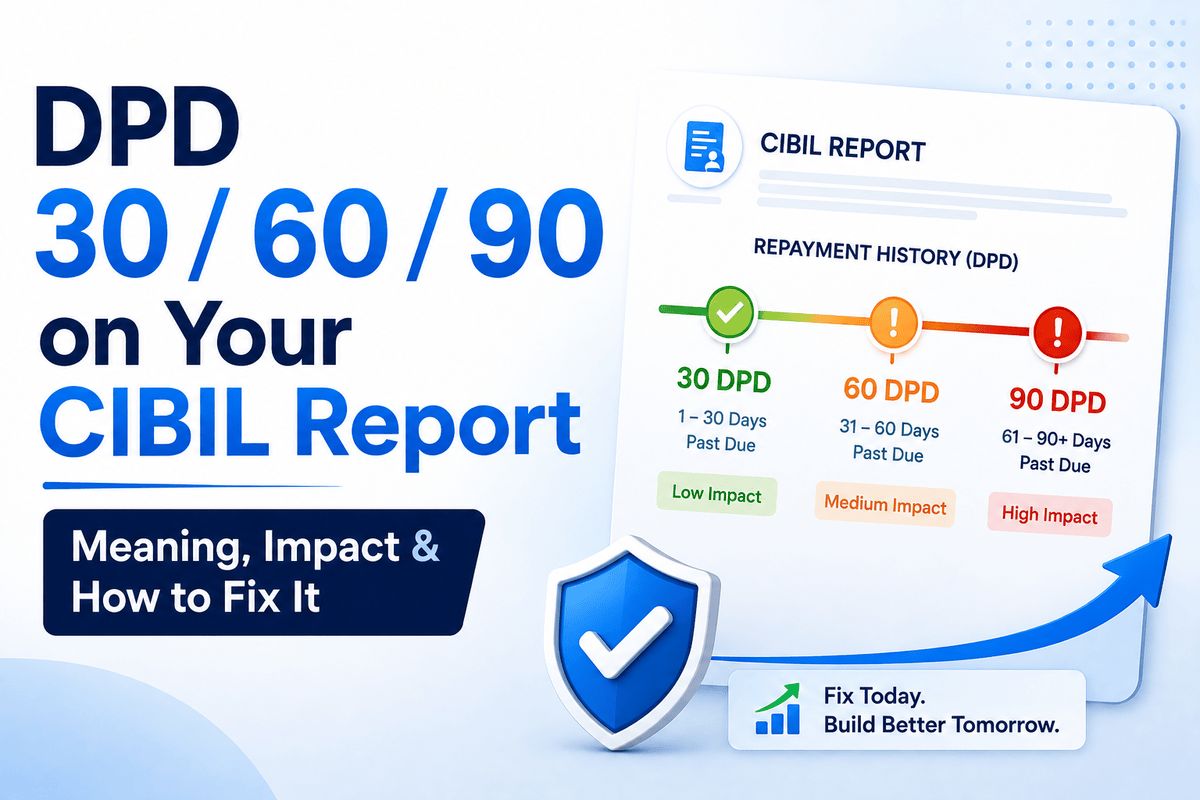
If you see DPD 30, 60 or 90 against a loan or credit card in your credit report, it means a payment was overdue. DPD stands for Days Past Due and records how many days a scheduled payment remained unpaid. A 000 or STD entry generally indicates timely payment, while higher DPD values indicate increasing payment delays.
What Does DPD Mean in a CIBIL Report?
DPD means Days Past Due. It is used in the payment history of a credit account to show whether a loan EMI or credit card payment was made on time or remained overdue. The figure is generally shown month by month against the relevant account, allowing lenders to see your repayment pattern rather than only your current credit score.
For example, if an EMI was due on 5 June and remained unpaid for 30 days, the account may show a DPD value of 30 for that reporting period. A later month with a longer delay may show 60 or 90. This makes DPD in a CIBIL report an important part of understanding your payment history.
Your credit score is a summary of your credit behaviour, while DPD gives more account-level detail about repayment delays. That distinction matters when you are checking a credit report before applying for a loan or trying to understand why a lender may view your application differently from what you expected.
DPD 000, 30, 60 and 90: What Do These Values Mean?
The easiest way to understand DPD 30 60 90 is to read the number as the number of days the payment was overdue for that reporting period. The higher the number, the more serious the repayment delay generally appears to a lender.
DPD value | What it generally indicates | What it means for your credit profile |
000 | Payment made on time | No days past due reported for that period |
STD | Standard account/payment status | Generally indicates regular repayment |
30 | Payment was 30 days overdue | Indicates a significant late payment |
60 | Payment was 60 days overdue | Indicates a more serious repayment delay |
90 | Payment was 90 days overdue | Indicates serious delinquency and may have wider lending implications |
90+ | Payment remained overdue beyond 90 days | May meet applicable NPA classification criteria for certain loan facilities |
A DPD entry should always be read with the account status and surrounding months. One isolated delay and a pattern of 30 → 60 → 90 are not the same situation from a lender’s risk perspective.
Does DPD 30 Affect Your Credit Score?
Yes, a reported late payment can negatively affect your credit profile because repayment behaviour is an important part of credit assessment. However, there is no universal rule saying that DPD 30 will reduce every borrower’s score by a specific number of points. The actual effect depends on factors such as the rest of your repayment history, existing accounts and other information in the credit file.
A DPD 30 entry is therefore worth addressing quickly rather than waiting for it to become a longer delinquency. If the payment was actually made on time but was reported incorrectly, the issue is different: you should verify the lender’s records and raise a dispute with the relevant credit bureau.
The difference between a single late payment and repeated late payments also matters. A recent sequence of overdue payments can signal continuing repayment stress, whereas an older isolated entry may be viewed differently during a lender’s overall assessment.
How Much Does DPD 60 or 90 Hurt Your Credit Profile?
DPD 60 and DPD 90 indicate that a payment remained overdue for considerably longer than a short payment delay. As delinquency increases, the account can become a stronger negative signal during credit assessment, particularly when the pattern is recent or repeated.
A DPD 60 entry suggests that the overdue amount was not cleared within the earlier 30-day period. At this stage, resolving the outstanding amount should be a priority. Continuing to leave the account unpaid can push the delinquency further and increase the seriousness of the account status.
A DPD 90 entry is more serious. Under RBI’s prudential framework, a term-loan instalment or principal/interest amount remaining overdue for more than 90 days can result in NPA classification, subject to the applicable facility and regulatory rules. This is why borrowers should not treat a 90-day delay as simply another late-payment entry.
The exact effect on your credit score cannot be reduced to a fixed “X points” formula. Credit scores are calculated from the broader credit file, so two borrowers with the same DPD entry may not experience identical score movements.
How Long Does DPD Stay on Your Credit Report?
A DPD entry is part of your reported repayment history, so paying the overdue amount does not necessarily make the historical entry disappear immediately. Credit reports retain payment-history information for a period determined by the bureau’s reporting framework, and lenders can consider both recent and older repayment behaviour when assessing an application.
This is why clearing an overdue EMI is only the first step. After the account is regularised, the practical goal is to build a consistent record of on-time payments in subsequent reporting periods.
If your credit report contains an accurate DPD entry, you generally cannot simply ask the bureau to erase it because it is inconvenient. If the information is inaccurate, however, you have grounds to dispute it and request correction.
How to Fix DPD on Your CIBIL Report
You cannot legitimately remove an accurate late-payment record simply because it has affected your credit profile. What you can do is stop the delinquency from worsening, correct inaccurate reporting and build a stronger repayment history going forward.
1. Clear the overdue amount
If an EMI or card payment is still outstanding, contact the lender and understand the exact amount required to regularise the account. Keep the payment confirmation and account statement for your records.
2. Check whether the DPD is accurate
Compare the DPD entry with your bank statement, payment receipt and lender records. If you paid within the required time but the account shows a late payment, gather the supporting documents before raising a dispute.
3. Dispute an incorrect entry
An incorrect DPD in CIBIL should not be ignored. Raise a dispute with the relevant bureau and, where appropriate, contact the lender that supplied the information. Provide clear evidence such as payment receipts, transaction references and account statements.
4. Prevent another missed payment
Once the account is regularised, focus on preventing another delay. Set EMI reminders, maintain sufficient balance before the due date and use automatic payment instructions where suitable.
5. Keep new credit applications under control
After a repayment issue, avoid applying for multiple loans or credit cards simply to compensate for the damaged profile. Hard enquiries and new borrowing can add further pressure to your credit profile, particularly if your existing repayment position has not stabilised.
6. Keep credit utilisation manageable
Your repayment history is not the only part of your credit profile. If you use credit cards, monitor your outstanding balances and avoid allowing balances to remain unnecessarily high relative to available limits.
Can a Credit Score Recover After DPD?
Yes, your credit profile can improve over time, but recovery is not immediate. The most useful approach is to stop further late payments and establish a sustained pattern of timely repayment. Older negative information may become less influential as newer positive repayment behaviour builds around it.
If a previous credit score drop happened because of a genuine payment delay, focus on the underlying behaviour rather than trying to find a quick score-fixing shortcut. Regular payments, controlled borrowing and accurate reporting are more sustainable than repeatedly applying for new credit.
A Credit builder can also be useful as part of a broader credit-health strategy when it is designed around responsible repayment rather than simply encouraging more borrowing. The objective should be to demonstrate consistent credit management over time.
How Credit Assist Can Help You Monitor Your Credit Health
Credit Assist can help you keep track of your credit profile and understand the factors that may need attention. Instead of looking only at the headline score, reviewing account-level information, repayment behaviour and reported changes can help you identify issues earlier.
For someone recovering from a late-payment record, regular monitoring can make it easier to check whether reported information has been updated correctly and whether repayment behaviour is improving. The goal is not to chase a particular score overnight but to build healthier credit habits and make better-informed borrowing decisions.
What Should You Do If You See DPD 30, 60 or 90?
Do not panic, but do not ignore it either. First identify the account, verify the overdue amount and check whether the reported information is accurate. If money is still outstanding, work with the lender to regularise the account. If the entry is incorrect, dispute it with supporting evidence.
Once the issue is resolved, the focus should shift to consistent repayment. Your credit history is built over time, and a period of responsible credit management can provide stronger evidence of financial discipline than a short-term attempt to change the score.
Frequently Asked Questions
What does DPD mean in a CIBIL report?
What does DPD 000 mean?
Is DPD 60 worse than DPD 30?
Is DPD 90 an NPA?
How often is DPD updated?
About the Author
Khushi Mishra
@khushi.mishra@paymeindia.in
View all posts →