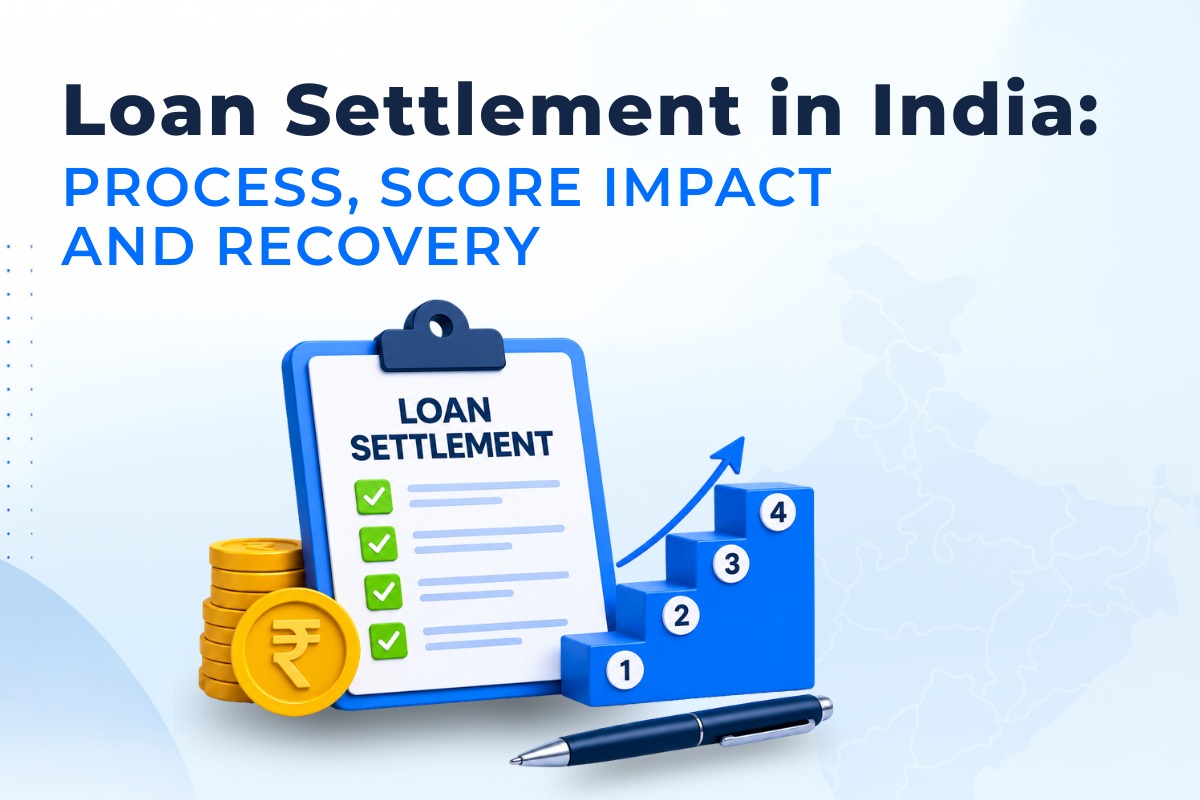
Loan Settlement in India: Process, Score Impact and Recovery (2026)
❤️ Spread the Love
A loan settlement happens when a lender agrees to accept less than the total amount due from a borrower, usually because the borrower is unable to repay the full outstanding amount. The account is generally reported as “Settled” rather than “Closed”, which can negatively affect the borrower’s credit profile and future access to credit.
If you are considering a settlement or already have a settled account, understanding the loan settlement CIBIL score impact is important. The effect does not end when you pay the agreed settlement amount. Your credit report, future loan applications and the way lenders assess your repayment history can all be affected.
What Is Loan Settlement?
Loan settlement is an arrangement where a lender accepts a mutually agreed amount that is lower than the borrower's total outstanding dues. It is generally considered when the borrower is facing financial difficulty and cannot repay the full amount according to the original repayment schedule.
For example, suppose ₹2 lakh remains outstanding on a personal loan and the lender agrees to accept ₹1.3 lakh as a one-time settlement. After the agreed amount is paid, the lender may close the account in its own books but report the account as “Settled” to the credit information company. This is why loan settlement and loan closure should not be treated as the same thing.
The key issue is not simply that the account has been resolved. It is how the account is reported and what that status tells a future lender about your repayment history.
Loan Settlement vs Loan Closure: What Is the Difference?
The most important difference between settled vs closed is whether the borrower has repaid the full amount due under the loan agreement. A closed account generally indicates that the outstanding dues were fully repaid, while a settled account indicates that the lender accepted less than the amount originally payable.
Factor | Loan Settlement | Loan Closure |
Amount repaid | Less than total dues | Full dues repaid |
Credit report status | Settled | Closed |
Meaning to future lenders | Original repayment obligation was not fully met | Loan was fully repaid |
Credit impact | Can negatively affect credit profile | Generally does not carry the same negative implication |
Future borrowing | May make lenders more cautious | Normal credit history continues |
This distinction is central to understanding the loan settlement impact on credit score. Paying the negotiated settlement amount does not automatically make the account equivalent to a normally repaid and closed loan.
How Does Loan Settlement Affect Your CIBIL Score?
A loan settlement can negatively affect your CIBIL score because the account is reported as “Settled” rather than “Closed”. The exact score reduction is not identical for every borrower because credit scores depend on the overall credit history and information in the credit report.
The research brief for this article uses a commonly cited impact of approximately 75 to 150 points, while several current sources cite a 75–100 point range. Therefore, the number should be treated as an indicative range rather than a guaranteed deduction for every borrower.
The actual damage may also reflect the missed payments that happened before settlement. If several EMIs were already overdue, those repayment issues may have affected the credit profile before the settlement status was reported.
This is why searching only for “how many points does loan settlement reduce CIBIL score” can give an incomplete picture. The settlement status, previous payment behaviour, outstanding debt and subsequent repayment history all matter.
How Long Does a Settled Loan Stay on Your Credit Report?
A settled loan can remain visible on the credit report for up to seven years, according to multiple current consumer-finance sources. However, the presence of the status for seven years does not mean the credit score remains unchanged throughout that period. Your subsequent credit behaviour continues to matter.
A common misunderstanding is that once the settlement amount is paid, the negative information disappears immediately. It does not. The lender reports the account status, and the credit information company reflects the information in the credit report.
This is also why rebuilding credit after settlement requires more than simply waiting. Making future payments on time, keeping new borrowing manageable and checking your credit report for accurate reporting are important parts of the recovery process.
Should You Settle a Loan or Explore Other Options?
Loan settlement should generally be considered only after you understand the alternatives available from your lender. Depending on your circumstances, you may be able to discuss restructuring, a longer repayment tenure, revised repayment terms or other arrangements before moving towards settlement.
The right option depends on your financial situation and the lender's willingness to modify the repayment arrangement. If you can continue repayment by reducing the monthly burden, restructuring may avoid the “Settled” status associated with a negotiated settlement.
Before agreeing to an one-time settlement (OTS), ask the lender for the terms in writing. Confirm the amount payable, payment deadline, treatment of the remaining dues and how the account will be reported to the credit bureau.
If your financial difficulty is temporary, discuss the problem with the lender before the account deteriorates further. Early communication can give you more options than waiting until repayment has become impossible.
What Is the Loan Settlement Process?
The loan settlement process usually starts when a borrower is unable to meet the original repayment obligation and approaches the lender to discuss a resolution. The lender assesses the account and circumstances before deciding whether to offer a settlement and on what terms.
A typical process can involve:
Discuss the repayment difficulty with the lender: Explain why you cannot continue with the existing repayment schedule.
Understand the settlement offer: Check the total outstanding amount and the proposed settlement amount.
Get the agreement in writing: Do not rely only on verbal communication.
Pay the agreed amount: Follow the lender's specified payment method and deadline.
Collect documentation: Keep the settlement letter, payment receipts and any other documents issued by the lender.
Check your credit report: After the lender updates the account, verify that the reported information is accurate.
A settlement should not be treated as a simple “pay less and forget the loan” arrangement. The documentation you receive can become important later if you want to correct or update the account status.
Can You Change a “Settled” Status to “Closed”?
In some cases, a borrower may be able to change a settled loan status to closed by subsequently paying the amount that the lender had previously waived, subject to the lender's agreement and process. Current consumer-finance guidance describes the process as approaching the lender, paying the remaining amount, obtaining a No Dues Certificate or equivalent documentation, and ensuring the lender updates the credit information company.
Step 1: Contact the Original Lender
Ask the lender whether it will accept payment of the remaining amount after settlement and update the account status from “Settled” to “Closed.” Do not assume that paying an amount independently will automatically change the reporting.
Step 2: Pay the Remaining Amount
If the lender agrees, obtain the exact amount payable and payment instructions in writing. Keep proof of the transaction after making the payment.
Step 3: Collect the NOC or No-Dues Documentation
After payment, request a No Objection Certificate (NOC) or relevant no-dues documentation from the lender. Keep the document safely because it can support a future correction request.
Step 4: Check Your Credit Report
Once sufficient time has passed for the lender's update, obtain your credit report and check whether the account status has been updated correctly. If the information is inaccurate or has not been updated, contact the lender and the relevant credit information company through their dispute mechanisms.
The process is not necessarily instant, so retaining your settlement documents, payment proof and lender correspondence is important.
How to Recover Your Credit Score After Loan Settlement
If you are trying to rebuild your CIBIL score after a loan settlement, focus first on accurate credit reporting, timely payments and manageable credit utilisation. Avoid taking new debt simply to create credit activity, especially when existing obligations are still difficult to manage.
A practical CIBIL recovery after settlement plan can look like this:
Period | What to Focus On |
Month 1–3 | Check your credit report, verify the settled account and clear any current overdue amounts |
Month 3–6 | Pay every active EMI and credit-card bill on time; avoid unnecessary credit applications |
Month 6–12 | Keep credit utilisation manageable and maintain stable repayment behaviour |
Month 12–18 | Review changes in your credit profile and continue timely payments |
Month 18–24 | Maintain the same behaviour and avoid taking unnecessary new debt |
The 12–24 month period in the content brief is a practical recovery window, not a guaranteed timeline for reaching a particular score.
Your starting score, number of overdue accounts, settlement history, current debt and subsequent repayment behaviour can all influence how quickly your credit profile improves.
What Should You Not Do After Loan Settlement?
After loan settlement, avoid taking multiple loans simply because you are worried about your reduced access to credit. Multiple applications can create additional enquiries, while taking new debt that you cannot comfortably service can create another repayment problem.
Do not ignore your credit report either. Check whether the settled account has been reported accurately and whether other overdue information remains unresolved. If you find incorrect information, raise the issue with the lender and the relevant credit information company.
You should also avoid paying a third-party service that promises to “erase” your credit history without first understanding what it can legally and practically change. A legitimate correction is based on accurate information and supporting documentation.
Can You Get a Loan After Settlement?
Yes, getting a loan after settlement is possible, but a settled account can make lenders more cautious when evaluating a new application. The lender may consider your current income, repayment capacity, existing obligations, credit history and the reason for the previous settlement.
A borrower should therefore avoid assuming that a recovered credit score alone guarantees approval. The “Settled” history may still be visible to lenders even as other parts of the credit profile improve.
If borrowing is necessary after settlement, focus first on affordability and repayment capacity rather than simply looking for lenders willing to approve a lower score.
Can a Credit Builder Help After Loan Settlement?
A credit builder approach can be useful when the goal is to establish consistent positive credit behaviour after a settlement rather than immediately seeking a large loan.
The basic principle is straightforward: use available credit responsibly, keep balances manageable and make every payment on time. Depending on eligibility, a secured credit card or another suitable credit product may provide an opportunity to rebuild a repayment track record.
Before taking any new credit product, however, check its fees, interest rate, repayment terms and whether you actually need the additional credit. The objective of credit rebuilding is to demonstrate responsible behaviour, not to accumulate more debt.
Credit Assist can also help users understand their credit position and work towards better credit health before taking another major borrowing decision.
How Credit Assist Can Help After Loan Settlement
Credit Assist focuses on helping users understand and manage their credit health. For someone dealing with a loan settlement CIBIL score issue, the first step is understanding what is currently appearing on the credit profile rather than immediately applying for another loan.
You can use the available information to identify areas that need attention, track your credit behaviour and make more informed decisions about future borrowing. If the settlement has already happened, this can be more useful than repeatedly applying for credit without addressing the underlying profile.
The focus should be on building a stronger repayment history over time, keeping existing obligations under control and checking that your credit information is being reported accurately.
Conclusion
Loan settlement can provide relief when full repayment is no longer manageable, but it comes with a credit-reporting consequence. A “Settled” account is different from a “Closed” account and can affect future borrowing. If settlement has already happened, focus on accurate reporting, resolving the remaining balance where possible and rebuilding consistent credit behaviour.
Frequently Asked Questions
How many points does loan settlement reduce your CIBIL score?
How long does loan settlement stay on your CIBIL report?
What is the difference between settled and closed?
Can a settled loan be converted to closed?
How long does it take to recover your credit score after settlement?
About the Author
Khushi Mishra
@khushi.mishra@paymeindia.in
View all posts →