How to Remove Settled Status from CIBIL Report
❤️ Spread the Love
Introduction
Two loans end. Both borrowers stop getting calls from the bank. Both feel relieved.
One report says Closed. The other says Settled. And for the next several years, those two people live in completely different financial worlds.
If you've ever accepted a bank's offer to "settle" a loan for less than you owed, this post is about the tag that offer left on your CIBIL report, and the specific, legal process to remove it.
What Does 'Settled' Mean in Your CIBIL Report?
Closed means you repaid the loan in full, as agreed. The account ended normally. Lenders see it and move on.
Settled means the bank accepted a reduced amount as final payment because you couldn't pay the whole thing. Say you owed Rs. 5 lakh on a personal loan, fell behind after a medical emergency, and the bank eventually agreed to close the matter for Rs. 2 lakh. You paid, the calls stopped, and it felt like the problem was over.
It wasn't. The bank reported the account to CIBIL as "Settled," which is bureau-speak for this person did not honour the full agreement. The tag typically drops your score by 75–100 points immediately, and it stays on your report for up to 7 years.
For completeness, there's an even worse tag: Written-Off, which means the bank gave up on recovering the money entirely. Lenders treat a settlement as "at least they tried to resolve it" and a write-off as "they walked away." Both are serious; write-off is worse.
How a Settled Tag Affects You
A settled tag doesn't just dent a number. In 2026, top-tier banks routinely reject applications outright when they see a settlement in the last 5–7 years, regardless of your current income. The lenders who will still deal with you tend to be the expensive ones: higher interest rates, tougher terms, more collateral demands.
Even fintech lenders, who approve almost everyone, screen for settled accounts. One word on your report quietly converts you into a high-risk borrower everywhere you go.
The Only Legal Way to Remove Settled Status
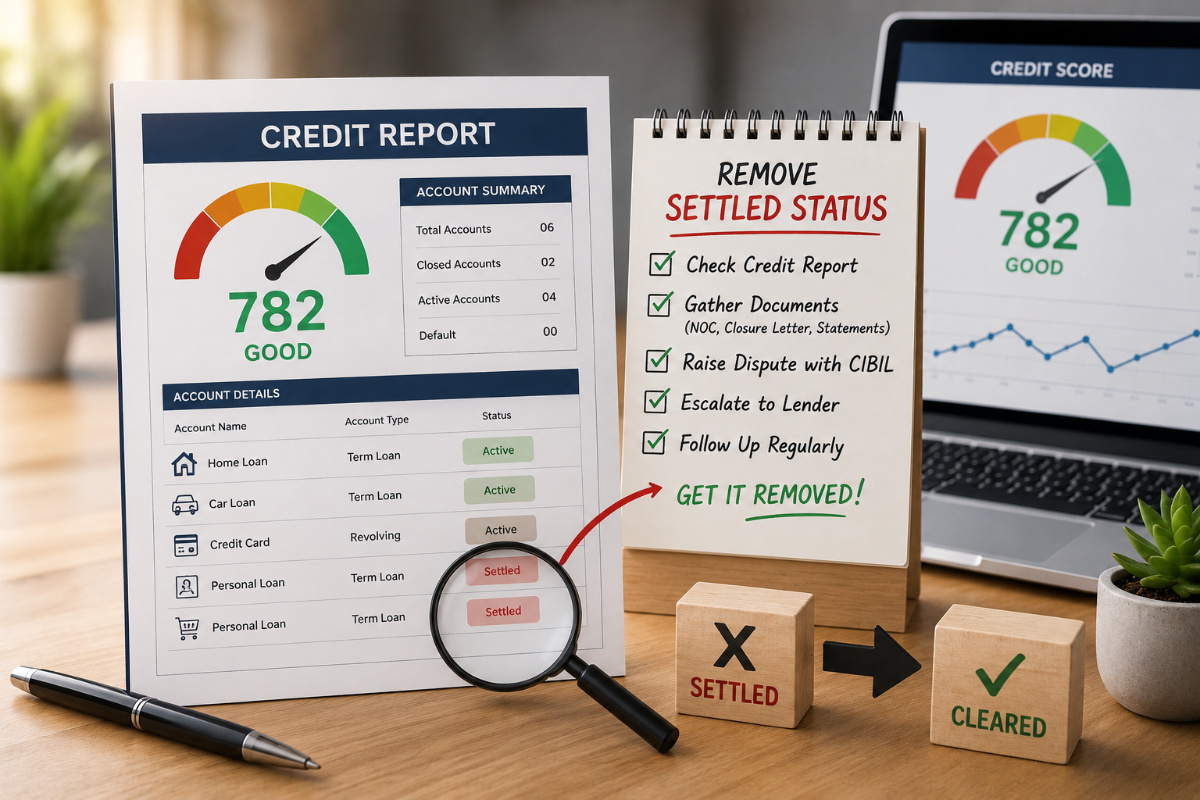
First, the biggest misconception: CIBIL cannot remove or change a settled status on its own, and no agent can "delete" it for a fee. Only the lender who reported it can update it, and they'll only do that for one reason: you paid the rest of the money. Here's the process.
Step 1: Identify the Exact Settled Account
Download your full CIBIL report and find the account marked "Settled" in the Account Information section. Note the lender, account number, and the outstanding or waived amount. You can't fix what you haven't precisely identified.
Step 2: Get the Payoff Amount from Lender in Writing
Reach out to the bank or NBFC that reported the settlement, through the branch, their grievance or nodal email, or customer care. Ask, in writing, for the exact remaining amount required to convert the account status from Settled to Closed, and where to pay it.
Insist on written responses. Verbal assurances from a branch have a way of evaporating later. If the branch stonewalls you, escalate to the regional office, collections department, or the lender's grievance cell.
Step 3: Pay Balance & Collect NOC / No Dues Certificate
Pay the confirmed amount and keep every receipt. Then obtain a No Objection Certificate (NOC) or No Dues Certificate from the lender, ideally one that explicitly states the account is closed with zero outstanding. This document is your weapon for everything that follows.
Step 4: Lender Updates Bureau or You Raise CIBIL Dispute
The lender is supposed to report the updated "Closed" status to CIBIL in their next reporting cycle. Sometimes they do. Sometimes it slips.
If the report still shows "Settled" after 30–45 days, raise a dispute directly on the CIBIL website and upload your NOC as evidence. CIBIL forwards the dispute to the lender, and once the lender confirms, the status is corrected, usually within 30 days.
Step 5: Verify Status Change & Start Rebuilding
Once the status flips to Closed, the bleeding stops, but the wound still needs healing. The years of missed payments that led to the settlement remain on your file. From here it's the standard rebuild: pay every current obligation on time, keep card utilization under 30%, avoid new applications for a while, and let clean months stack up. Expect meaningful recovery over 12–18 months.
Important Facts About the Process
Raising a dispute on CIBIL is free. You never need to pay anyone to file it.
Nobody can delete accurate negative information, whatever "CIBIL repair" agents claim. If it's wrong, dispute it yourself. If it's accurate, the only cure is repayment plus time.
Under the RBI-aligned framework, you may be entitled to compensation of Rs. 100 per day if a dispute drags beyond the 30-day resolution window in specific situations. Lenders know this; reminding them helps.
When You Need Legal Support
Most settled-status cases are straightforward paperwork. But some get messy: the lender's records are wrong, the NOC never arrives, an old account you never knew about surfaces as settled, or a recovery agent misreported a full payment as a settlement. These situations need formal notices, documented escalation, and someone who knows the regulatory pressure points.
That's exactly what Credit Assist's Pro Legal Support plan (Rs. 999, one-time) covers: expert review of your report, legal assistance, and notice drafting to push stuck cases through. If you've been going in circles with a lender for months, a properly drafted legal notice often accomplishes in weeks what polite follow-ups couldn't in a year.
How to Avoid Settlement in the Future
If you're currently struggling with EMIs and a bank offers a settlement, understand the price before you sign. Sometimes settlement is genuinely the only option, but treat it as the last one:
Ask about restructuring, extended tenure, or a payment holiday first.
Build an emergency fund covering 3–6 months of EMIs so one bad quarter doesn't become a default.
Talk to the lender before you miss payments, not after. Banks negotiate far more willingly with borrowers who come to them early.
Final Thoughts
A settled tag is repairable, but only through the legitimate route: full repayment, NOC, bureau update, and then 12–18 months of clean history. Anyone selling you a shortcut is selling you a story. Your future self, sitting in a loan officer's cabin in 2030, will thank you for starting the cleanup today.
Frequently Asked Questions
Q: How can I remove settled status from my CIBIL report?
Does a settled status affect my CIBIL score?
Can a settled status be removed without paying the outstanding amount?
About the Author
Himanshu Mishra
@himanshu
View all posts →