7 CIBIL Report Errors Hurting Your Score
❤️ Spread the Love
Introduction
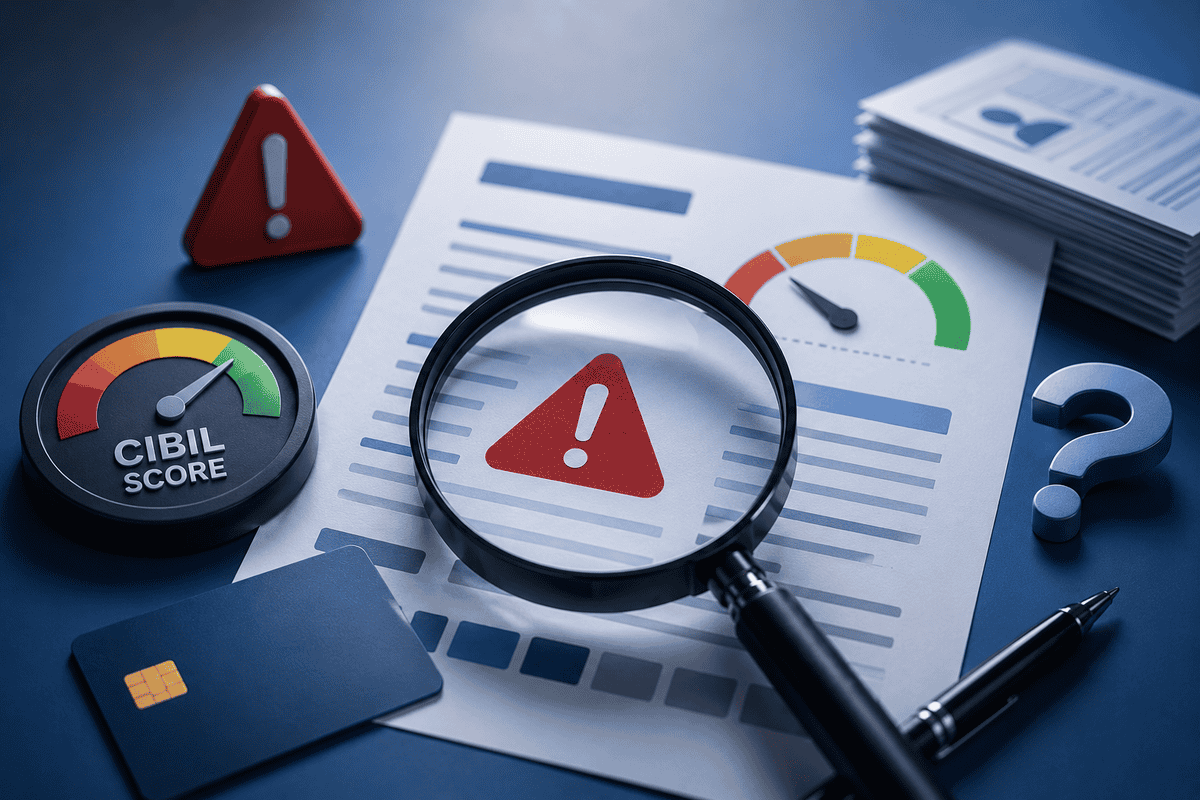
Here's an uncomfortable thought: your CIBIL score might be low because of something you never did.
Credit reports are assembled from data submitted by dozens of lenders, and lenders make data-entry mistakes constantly. A payment posted late in their system. An account that belongs to someone with your name. A closed loan nobody bothered to mark closed. Each error sits on your report, quietly bleeding points, until you find it and fight it.
The upside: fixing an error is the fastest legitimate score improvement that exists. No six-month discipline plan, no new products. Find the mistake, dispute it, and a corrected false default can jump your score more in 30 days than a year of good behaviour.
7 Most Common CIBIL Report Errors
1. Closed Loan Still Showing Active
You repaid the personal loan in 2023, but the report still shows it active with an outstanding balance. This inflates your total debt and makes you look over-leveraged to every lender who pulls your file. It's usually caused by the lender never reporting the closure. Your loan closure letter or NOC is the fix.
2. On-Time Payments Marked Late (DPD Errors)
The single most damaging error type, because payment history drives about 35% of your score. Look at the DPD (Days Past Due) grid for each account. Any entry other than "000" or "STD" for a month you know you paid on time is worth disputing, with your bank statement as evidence.
3. Accounts That Aren't Yours (Namesake Errors)
Someone with a similar name, or a mistyped PAN, gets their loan attached to your file. If they default, you take the hit. Scan the Accounts section for any lender you've never dealt with. This one can also be your first warning sign of identity theft, so treat it urgently.
4. Wrong Credit Limit on Your Card
If your card limit is Rs. 2 lakh but the bureau has it recorded as Rs. 50,000, your utilization ratio looks four times worse than reality. Since utilization is roughly 30% of your score, a wrong limit silently costs serious points. Cross-check every card's reported limit against your latest statement.
5. Incorrect 'Settled' or 'Written-Off' Tag
Sometimes an account you fully repaid is misreported as settled, often when a payment went through a recovery agent and got recorded as a compromise. This tag is toxic, and if it's genuinely wrong, a dispute backed by your NOC can remove it. We've covered the full settled-status cleanup in a separate guide.
6. Hard Inquiries You Never Made
The Enquiries section lists every lender who pulled your report. Applications you never made are a red flag for two reasons: each hard inquiry costs a few points, and unknown inquiries suggest someone may be applying for credit in your name.
7. Outdated Personal Information
Old addresses and stale phone numbers seem harmless, but mismatched personal details can cause your file to merge incorrectly with someone else's, or trigger verification delays on applications. Keep the basics current.
Step-by-Step CIBIL Dispute Process
Step 1: Gather Evidence (NOC, Statements, Receipts)
Bank statements, NOCs, closure letters, payment receipts. Disputes with documents attached resolve faster and more reliably than bare claims.
Step 2: Raise Dispute Free on CIBIL Portal
Log in at cibil.com, go to the dispute section, select the specific field that's wrong, and submit with your evidence. It's free. You do not need to pay any agent or "credit repair company" to file a dispute for you.
Step 3: Bureau Contacts the Lender
CIBIL itself cannot change lender-reported data; it forwards your dispute to the institution that reported it. The disputed field is marked "Under Dispute" on your report while this happens.
Step 4: Resolution Within ~30 Days
CIBIL estimates around 30 days for resolution, depending on how fast the lender responds. If the lender confirms the error, the report is corrected and your score recalculates.
Step 5: Escalate if the Lender Stonewalls
Some disputes bounce because the lender lazily "confirms" their own wrong data. Then you escalate: written complaint to the lender's grievance cell, then their nodal officer, then the RBI Ombudsman if needed. A formally drafted legal notice tends to concentrate a lender's attention wonderfully.
Your Rights During a Dispute
Filing a dispute is free, always, directly on the bureau's portal.
CIBIL targets roughly 30 days for resolution.
Under the RBI-aligned framework, compensation of Rs. 100 per day may apply in certain cases where resolution drags past the window. Mentioning this in escalation emails is remarkably effective.
How Often Should You Check Your Report?
At minimum, twice a year. Monthly is better, and it costs you nothing score-wise: checking your own report is a soft inquiry with zero impact on your score, whatever the WhatsApp forwards claim.
The practical problem is that a raw CIBIL PDF is 15 pages of dense tables, and most people's eyes glaze over by page 3. Errors hide comfortably in that fog.
How Credit Assist Makes Error-Hunting Easy
Credit Assist pulls your live score and decomposes it factor by factor, flagging the entries dragging you down, so an error stands out instead of hiding in a grid of numbers. Basic Access (Rs. 99/month) gives you the full report and breakdown; and if a lender won't budge on a legitimate dispute, our Pro Legal Support plan (Rs. 999) handles the escalation and notice drafting for you.
Final Thoughts
Your score should reflect your behaviour, not a bank's typo. Pull your report this week and read it like an auditor: every account, every DPD entry, every inquiry. There's a decent chance you're owed points you never knew you lost, and unlike every other score improvement, this one can land within 30 days.
Frequently Asked Questions
Q: How do I dispute an error in my CIBIL report?
About the Author
Himanshu Mishra
@himanshu
View all posts →