Credit Card Minimum Due vs Full Payment: The Real Cost
❤️ Spread the Love
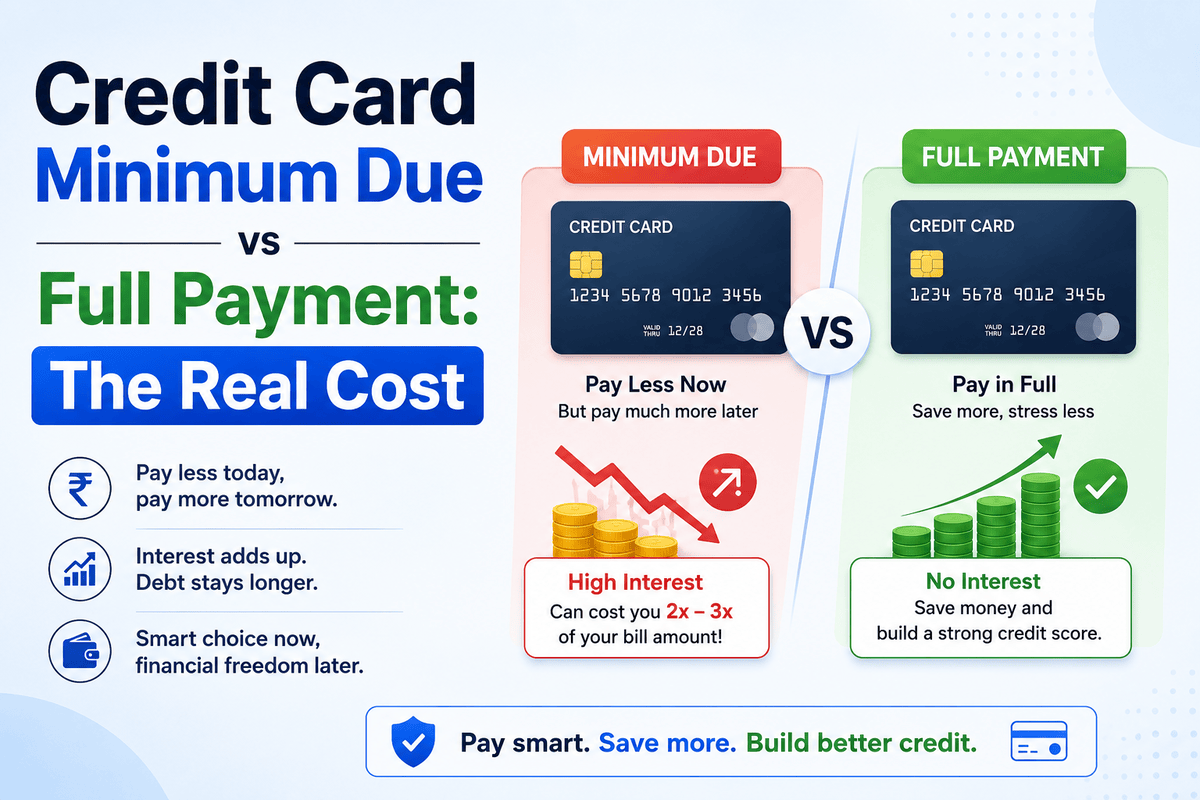
Paying the minimum due on a credit card keeps your account from being treated as unpaid for that billing cycle, but it does not clear your outstanding balance. The remaining amount can continue to attract interest and may increase your credit utilisation. Paying the total amount due by the due date generally helps you avoid interest on eligible purchases within the interest-free period.
If you use a credit card regularly, understanding the difference between minimum due vs full payment is important. The minimum payment can look affordable on a tight-budget month, but repeatedly carrying a balance can make a relatively small bill expensive over time.
What Is the Minimum Due on a Credit Card?
The minimum amount due is the smallest amount your card issuer requires you to pay by the due date to keep the account in good standing. It is only a portion of the total outstanding amount, so paying it does not mean that your credit card bill has been fully paid.
For example, suppose your credit card statement shows:
Total amount due: ₹40,000
Minimum amount due: ₹2,000
Payment made: ₹2,000
Your immediate payment obligation for that billing cycle has been met, but ₹38,000 remains outstanding. That unpaid balance can attract applicable finance charges according to your card's terms.
This is why minimum due vs total due should not be viewed as two different ways of clearing the same bill. One keeps the account current for the payment cycle; the other clears the outstanding balance.
What Is Full Payment or Total Amount Due?
Full payment means paying the total amount due shown on your credit card statement by the specified due date. When the applicable conditions for the interest-free period are met, paying the full amount can help you avoid interest on eligible purchases.
The total amount due represents the amount you need to pay to clear the statement balance. It is therefore the figure to focus on if your objective is to avoid carrying revolving credit card debt.
For someone trying to maintain a healthy credit score, full payment also has another advantage: you are less likely to carry a high balance into the next billing cycle, which can help keep credit utilisation under control.
What Happens If You Pay Only the Minimum Due?
When you pay only the credit card minimum due, the remaining balance is carried forward. The exact interest calculation depends on your card's terms, but carrying a balance can result in finance charges and the loss of the interest-free benefit applicable to new purchases.
The problem becomes bigger when minimum payments turn into a habit. A ₹30,000 balance may feel manageable when the minimum due is only a small portion of it, but the unpaid principal can remain for several billing cycles while interest continues to accumulate.
Your payment may therefore appear affordable each month while the underlying debt takes much longer to clear. This is one reason financial education around credit card repayment should focus on the total cost, not just the minimum amount displayed on the statement.
Minimum Due vs Full Payment: A Simple Example
Consider a hypothetical credit card bill of ₹50,000. Assume the minimum due shown on the statement is ₹2,500 and the card carries an annualised interest rate of 36%. The actual calculation on a credit card can vary based on the issuer's terms, transaction dates, taxes and other charges, so this example is only for understanding the difference.
If you pay ₹50,000 in full by the due date, the eligible purchases can generally remain within the interest-free period.
If you pay only ₹2,500, the remaining ₹47,500 is carried forward. Interest can then apply according to the card's terms, increasing the cost of carrying that balance.
This is why paying the minimum due should be treated as a short-term cash-flow solution, not a long-term repayment strategy. Current consumer-finance guidance similarly highlights that carrying balances can increase interest costs and prolong repayment.
Does Paying Only the Minimum Due Affect Your Credit Score?
Paying at least the minimum due on time is different from missing the payment altogether. It generally helps avoid a late-payment situation for that billing cycle, subject to the card issuer's reporting and applicable rules.
However, consistently paying only the minimum can still affect your credit profile indirectly because the unpaid balance keeps your credit utilisation elevated.
Credit utilisation refers to how much of your available revolving credit you are using. For example, if your credit limit is ₹1 lakh and your outstanding balance is ₹60,000, your utilisation is 60%.
A high utilisation ratio can signal greater dependence on available credit and may negatively affect your credit score. The effect is not necessarily immediate or identical for every borrower, but maintaining manageable utilisation is an important part of responsible credit management.
Why Credit Utilisation Matters for a Good CIBIL Score for Loan Approval
If your objective is to maintain a Good CIBIL score for loan applications, paying the minimum every month may not be enough. Lenders consider multiple aspects of your credit profile, including repayment history, outstanding debt, credit utilisation and recent credit activity.
There is no single CIBIL score that guarantees approval because lenders use their own eligibility criteria. However, current Indian lending guidance commonly identifies 750 and above as a strong or excellent range, while also emphasising that income, repayment capacity and other credit factors matter.
This makes credit card repayment behaviour particularly relevant before applying for a personal loan. A cardholder who regularly carries a large balance may have a different credit profile from someone using the same credit limit but clearing the bill every month.
Is Paying the Minimum Due Ever Useful?
Yes. If you genuinely cannot pay the full bill by the due date, paying at least the minimum due can be preferable to missing the payment entirely. It can help keep the account from being treated as unpaid for that cycle, although the remaining balance may continue to attract applicable charges.
The important point is what you do next.
If you pay the minimum because of a temporary cash-flow problem, aim to clear the remaining balance as soon as possible. Avoid continuing to make new discretionary purchases on the same card while carrying a costly balance.
If the balance is becoming difficult to manage, contact the issuer and understand available repayment or EMI-conversion options instead of allowing the outstanding amount to continue growing unchecked.
What Should You Do If You Cannot Pay the Full Credit Card Bill?
If you cannot make full payment, focus on reducing the balance rather than repeatedly paying only the minimum. Even an additional part-payment can reduce the outstanding principal on which applicable charges may be calculated.
A practical approach is:
Pay at least the minimum due by the deadline.
Make an additional payment whenever cash flow allows.
Stop unnecessary card spending until the balance is under control.
Prioritise clearing high-cost revolving debt.
Track your credit utilisation.
Return to full payment once the outstanding balance is manageable.
This approach is more sustainable than treating the minimum amount as the monthly target. Your goal should be to clear revolving debt, not simply keep the card active.
Can Secure Credit Cards Help Build Credit?
Secure credit cards, more commonly referred to as secured or FD-backed credit cards, can be an option for people who are new to credit or have difficulty qualifying for an unsecured card. These cards are typically backed by a fixed deposit and can provide access to a credit facility while using the deposit as security.
However, getting a secured card does not automatically improve your credit score. The benefit comes from responsible usage and repayment behaviour that is appropriately reported to credit information companies.
If you use a secured card, the same rule applies: keep spending manageable and pay the statement balance on time whenever possible.
A Credit builder strategy should be about creating a consistent repayment record, not taking on debt simply to increase your credit activity.
How Credit Assist Can Help You Manage Credit Better
Credit Assist can help users understand their credit profile and make more informed decisions about credit usage. This is particularly useful if you are trying to understand why your score has changed, whether your credit utilisation is high or what you can do before applying for a loan.
Rather than focusing only on the number displayed on your credit report, look at the behaviour behind it: payment history, outstanding balances, utilisation and recent applications.
Conclusion
The difference between minimum due vs full payment is not just the amount you pay today. Paying only the minimum can leave a balance that attracts interest and keeps utilisation elevated, while full payment can help you avoid revolving debt when you can afford it.
If you want to maintain a healthy credit profile and work towards a Good CIBIL score for loan eligibility, make full payment whenever your finances allow, keep utilisation manageable and treat your credit card as a payment tool rather than an extension of your monthly income.
Frequently Asked Questions
Is paying the minimum due the same as paying the credit card bill?
Does paying the minimum due affect my credit score?
Is it better to pay the minimum due or full payment?
What is a good CIBIL score for a loan?
Can a secured credit card help improve my credit score?
About the Author
Khushi Mishra
@khushi.mishra@paymeindia.in
View all posts →